Route 66 in Texas marks a noticeable shift in scale, as the landscape opens, distances lengthen, and the road begins to stretch across space rather than between closely connected towns. The horizon dominates the road, drawing the journey steadily toward it.
This page highlights selected locations and experiences along Route 66 in Texas, focusing on places that reflect the character of the route rather than attempting to document every stop along the way.
The Character of Route 66 in Texas
Route 66 in Texas feels defined by distance and openness. The road stretches across the Panhandle in long, unobstructed lines, where towns appear as intervals rather than continuations. The experience becomes less about proximity and more about the space in between.
This portion of the route emphasizes the idea of travel as movement through landscape. Wind, sky, and changing light become part of the journey, while roadside stops serve as markers within a larger, uninterrupted flow.
The distance between towns introduces a deeper sense of journey, while the continuity of landmarks and local efforts to preserve the road reinforce its enduring presence.
Cadillac Ranch — Amarillo
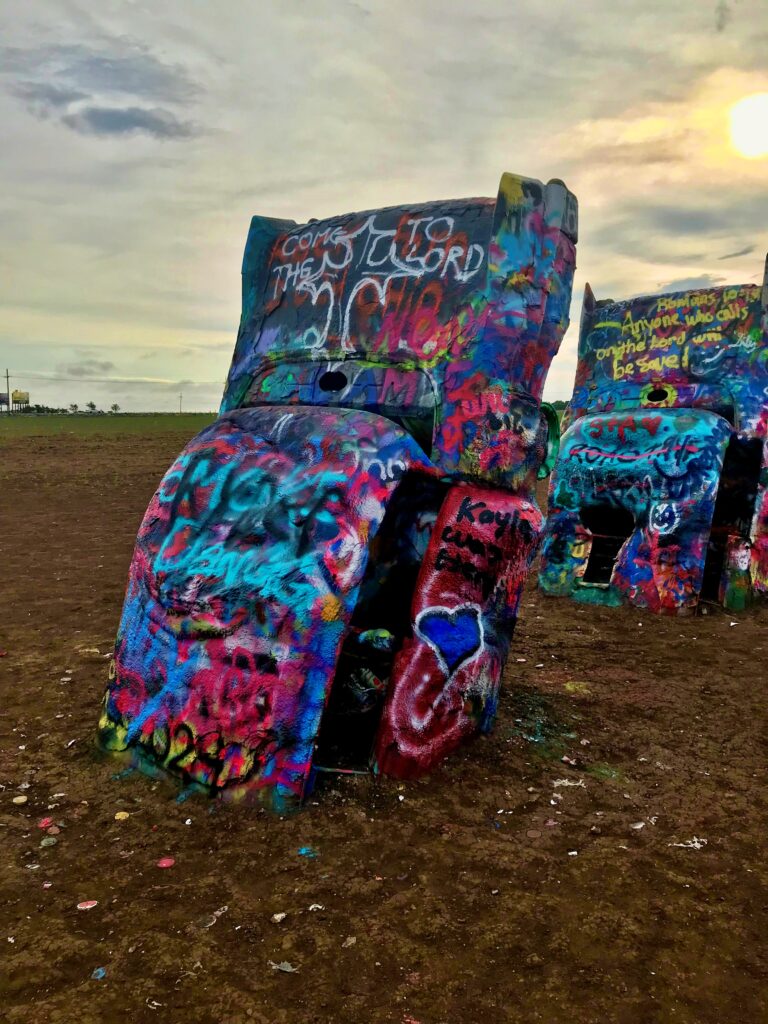
Cadillac Ranch near Amarillo, Texas — ten graffiti-covered Cadillacs half-buried nose-down in a field, repainted daily by visitors passing through on Route 66.
A row of classic Cadillacs buried nose‑first in the ground creates one of the most recognizable visual statements on Route 66. Constantly repainted by visitors, it reflects both preservation and participation, turning the roadside into an evolving canvas.
Big Texan Steak Ranch — Amarillo
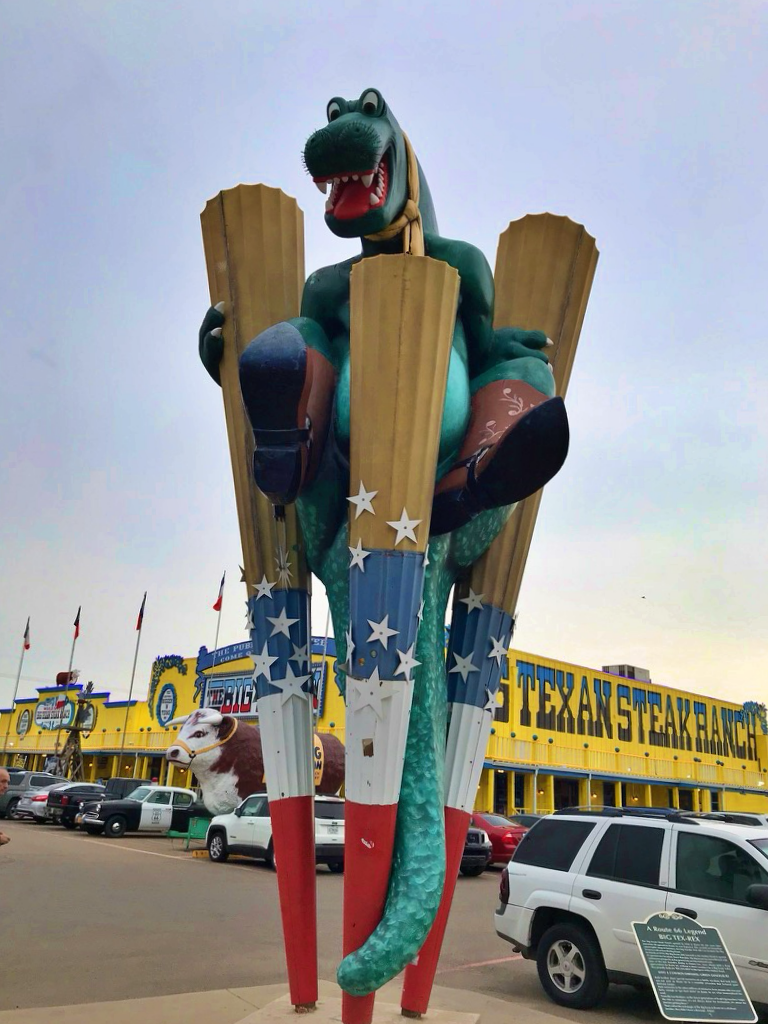
A well‑known stop along Route 66 in Texas, the Big Texan represents the bold, exaggerated roadside culture associated with long‑distance travel. Its scale and style reflect the performative aspect of the American highway experience.
Big Tex-Rex greets visitors outside the Big Texan Steak Ranch in Amarillo — a Route 66 legend and one of the quirkiest photo stops on the highway.
Route 66 Historic District — Amarillo
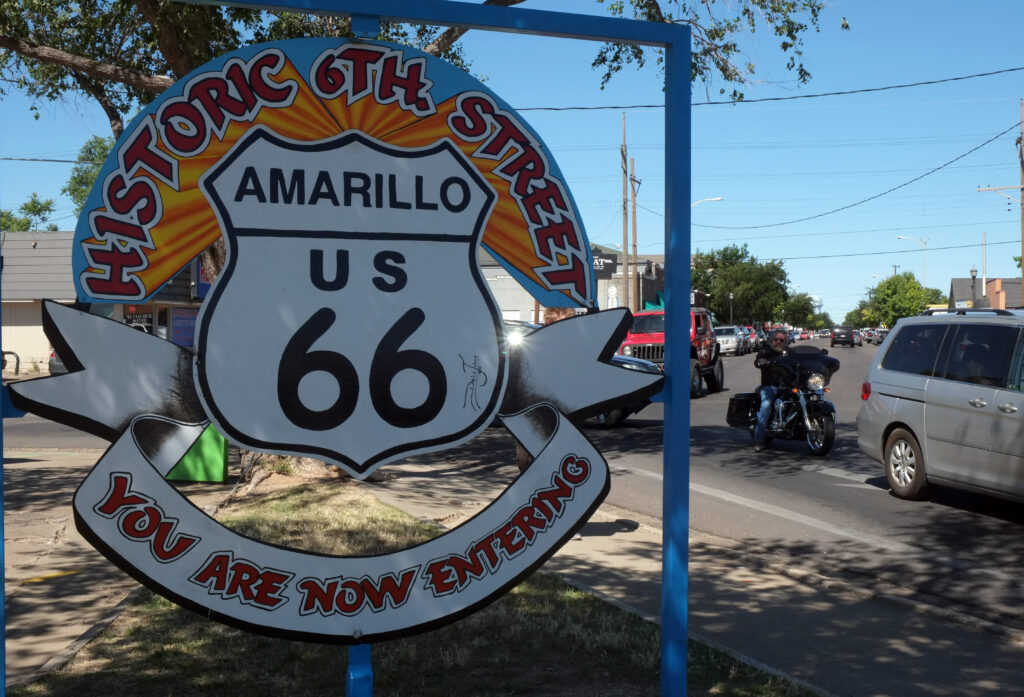
The “Historic 6th Street” sign welcomes travelers to Amarillo’s Route 66 district. Photo: Gorupdebesanez, CC BY-SA 4.0 https://creativecommons.org/licenses/by-sa/4.0, via Wikimedia Commons
This stretch of restored buildings and storefronts offers a concentrated look at how Route 66 once functioned as a commercial corridor. Neon signs and preserved facades connect the present to earlier decades of travel.
The district blends Spanish Revival, Art Deco, and Art Moderne architecture across roughly 13 blocks — a mix that earned it a spot on the National Register of Historic Places in 1994. Tucked into that same stretch is the GoldenLight Café & Cantina, serving burgers since 1946 and holding the distinction of being the oldest continuously operating restaurant on all of Route 66, not just in Texas.
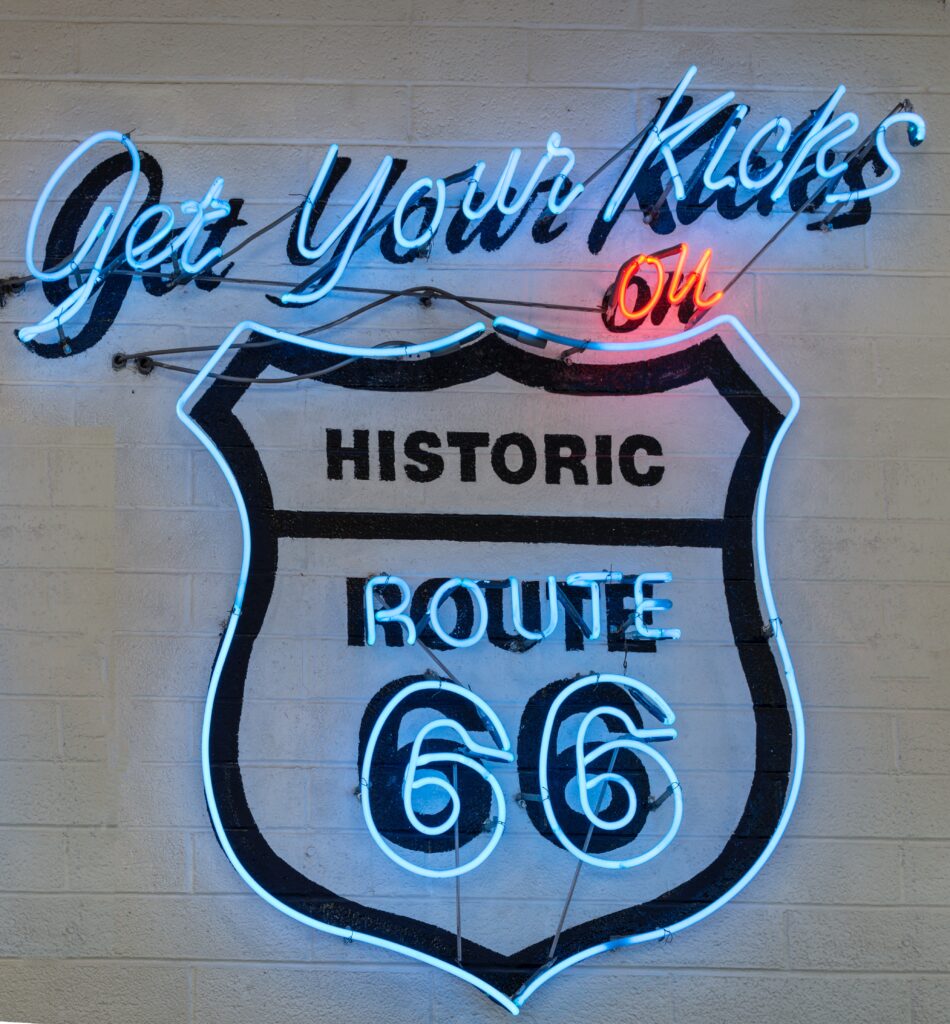
A neon “Get Your Kicks on Route 66” sign glows along Amarillo’s historic stretch of the Mother Road. Photo: Carol M. Highsmith, Public domain, via Wikimedia Commons
Amarillo earned its place in Route 66 lore in another way, too — it’s the only Texas city named in the classic “(Get Your Kicks on) Route 66” song, immortalized in the line “You see Amarillo, Gallup, New Mexico, Flagstaff, Arizona.” For a city that wasn’t even the road’s midpoint (that honor belongs to nearby Adrian), it’s a lasting bit of recognition for a stretch of highway that has otherwise shifted and rerouted more than once over the decades.
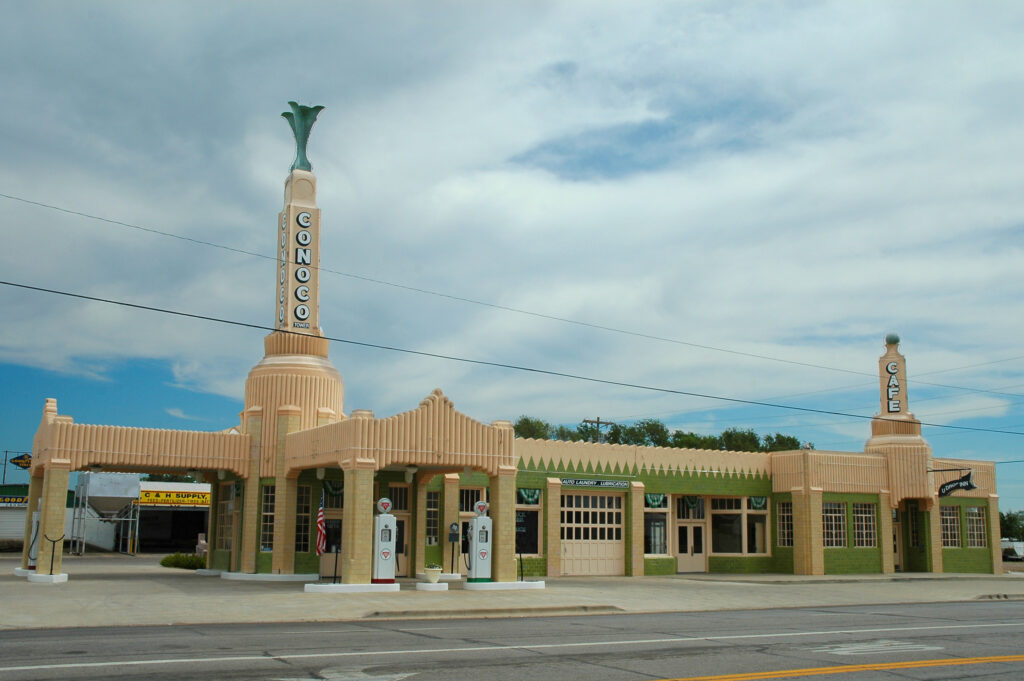
U‑Drop Inn / Tower Station — Shamrock
This Art Deco service station stands as one of the architectural highlights along Route 66. Carefully restored, it reflects a time when design and function were combined to create memorable roadside spaces.
Elvis Presley reportedly stopped in for breakfast here early one morning with his manager, Colonel Tom Parker, and there’s still a booth inside marked as the one he sat in.
The U-Drop Inn in Shamrock, Texas — a striking Art Deco gas station and café said to have inspired the design of Ramone’s House of Body Art in Pixar’s Cars. Photo: Clinton Steeds from Los Angeles, USA, CC BY 2.0 https://creativecommons.org/licenses/by/2.0, via Wikimedia Commons
Another fun fact: Pixar’s team toured Route 66 (led by historian Michael Wallis, who voiced the movie’s Sheriff), and the U-Drop Inn’s distinctive Art Deco design became the direct inspiration for Ramone’s House of Body Art in Cars. It’s even celebrated locally — Shamrock has a dedicated Cars memorabilia section inside the building, and the town was recently named Texas’s official symbol for the Route 66 centennial partly because of this connection.
Midpoint Café — Adrian
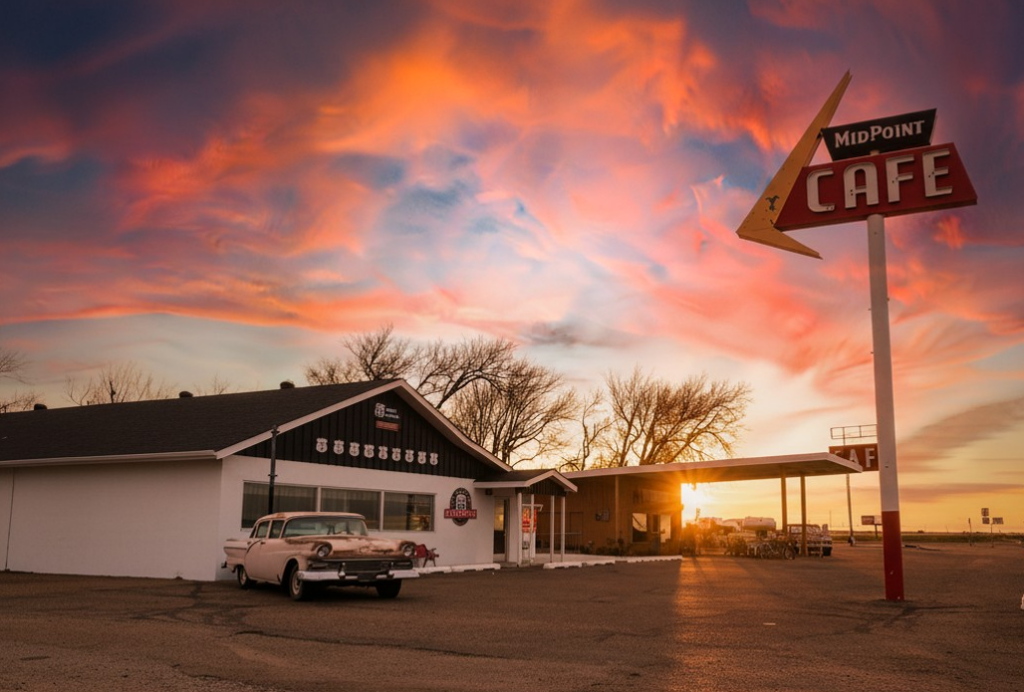
Located near the halfway point of Route 66, this café marks the symbolic center of the journey between Chicago and Santa Monica. It offers a moment of pause that emphasizes distance traveled and distance remaining.
The Midpoint Cafe in Adrian, Texas, marks the halfway point of Route 66 — 1,139 miles to Chicago, 1,139 miles to Los Angeles.
Roadside Culture & Landmarks
In Texas, Route 66 culture leans toward scale and symbolism. Landmarks often appear larger, more visible against the open landscape, and carry a sense of intentional presence rather than subtle integration.
Neon signs, restored stations, and distinctive attractions create focal points along otherwise quiet stretches, reinforcing the rhythm of long‑distance travel punctuated by moments of activity.
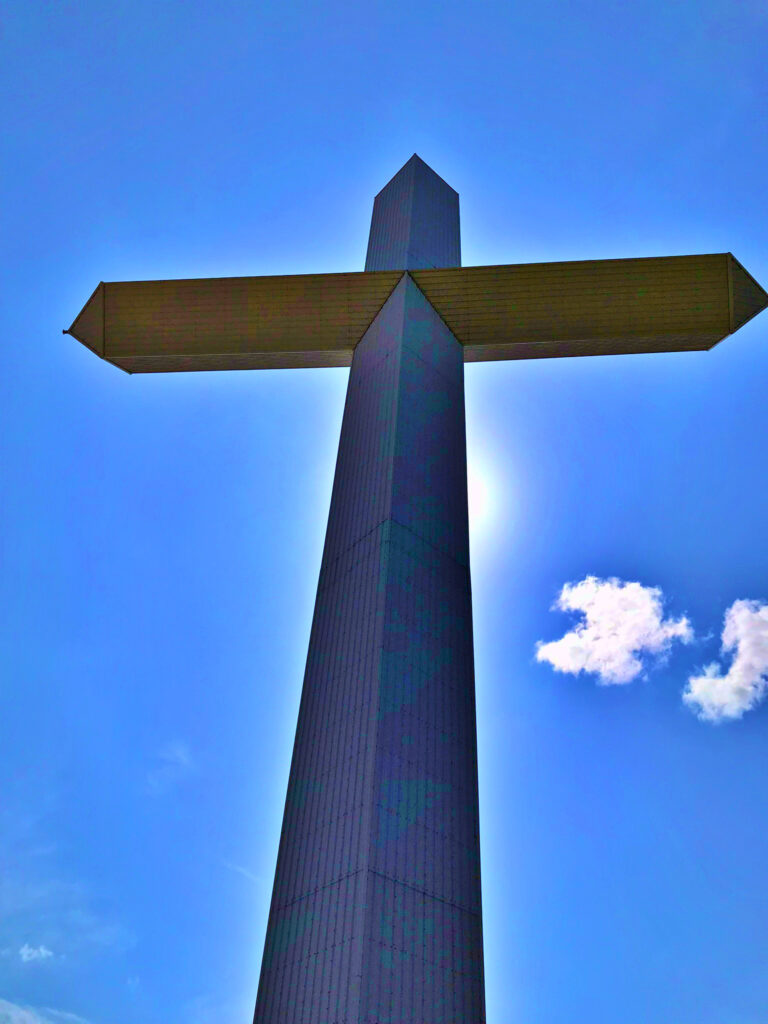
The Cross of Our Lord Jesus Christ towers 190 feet over Groom, Texas — one of the most striking landmarks along the Panhandle of Route 66.
Traveling Through Texas
Traveling Route 66 through Texas involves extended stretches between destinations, with fewer towns and wider gaps between stops. This introduces a slower, more contemplative pace, where the experience is shaped as much by the landscape as by the places themselves.
Weather and time of day can significantly affect the feel of the drive, with light and visibility playing a larger role in how the road is experienced.