Route 66 in Illinois

Route 66 in Illinois is where the road first took shape as both a practical route and an idea. Illinois represents the beginning of Route 66 both geographically and historically, helping to frame everything that follows.

In this stretch, the Mother Road is closely tied to cities, industry, and early roadside culture—marking the transition from rail travel to the open highway. From here, the road gradually opens and changes, transitioning into broader landscapes and longer distances as it moves west into Missouri.

This page highlights selected locations and experiences along Route 66 in Illinois, focusing on places that reveal the character of the route rather than attempting to document every mile or stop.

The Character of Route 66 in Illinois

Illinois is where the road was conceived, named, and first embraced as a way to move west by car rather than by train. Urban streets, brick buildings, and early highway infrastructure reflect a time when travel was becoming personal and mobile, but still closely connected to towns and neighborhoods.

Rather than wide‑open distances, the Illinois stretch is shaped by proximity—short drives between communities, layered histories, and roadside businesses built to meet travelers right where they were.

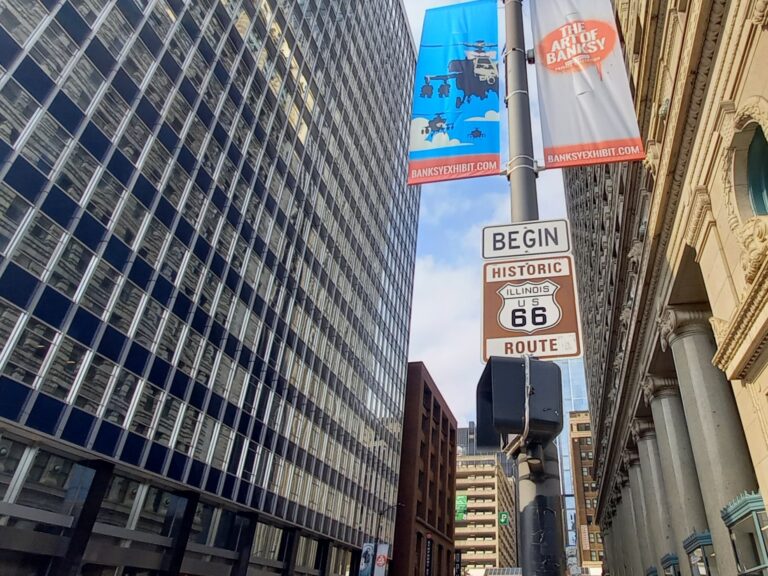
Route 66 Begin Sign – Chicago

The official starting point of Route 66 sits near downtown Chicago, marking the symbolic beginning of the journey west. 

The Begin Historic Route 66 sign in downtown Chicago, marking the start of the Mother Road at Adams Street
The Begin sign in downtown Chicago — where Route 66 officially starts. Photo: AlphaBeta135, CC BY 4.0 https://creativecommons.org/licenses/by/4.0, via Wikimedia Commons

 More than a photo stop, the sign represents the moment when Route 66 transitioned from a line on a map into a cultural idea.

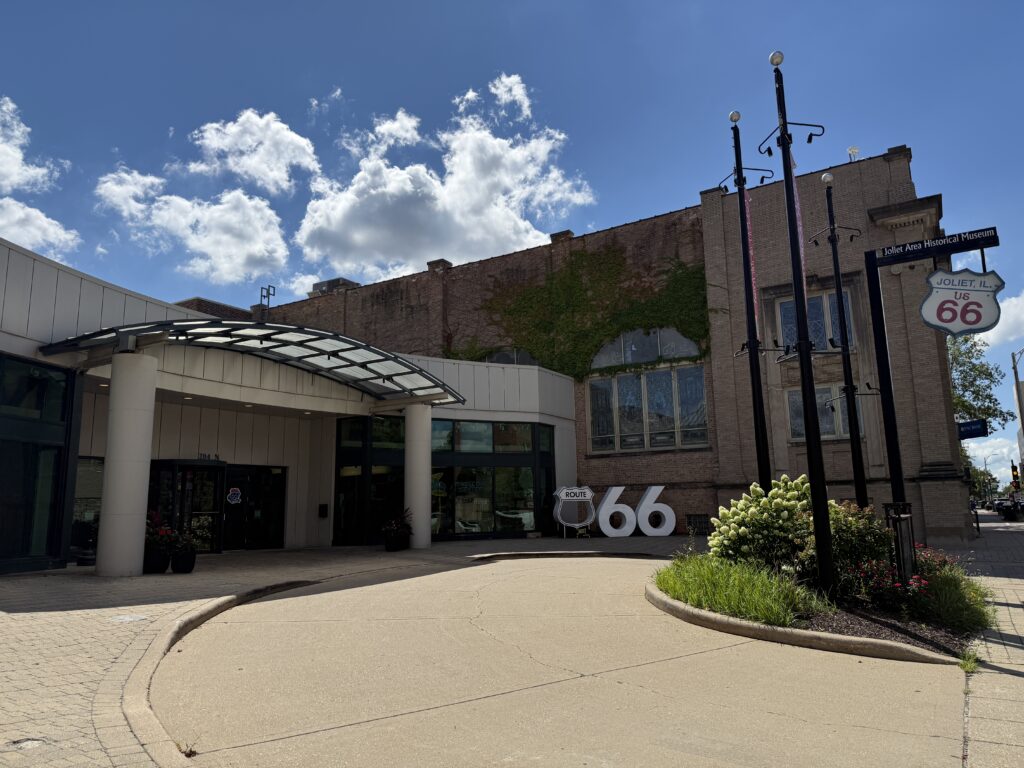
Joliet Area Historical Museum — Joliet

Housed in a former church, this museum serves as a gateway to Route 66 in Illinois. Exhibits trace the road’s development and its relationship to local communities, offering context before continuing west.

The entrance to the Joliet Area Historical Museum with a large Route 66 shield sign and "66" numerals displayed outside
The Joliet Area Historical Museum marks the town’s spot along the Mother Road, with a Route 66 shield. Photo: Dough4872, CC BY-SA 4.0 https://creativecommons.org/licenses/by-sa/4.0, via Wikimedia Commons

Route 66 Diner & Historical Sites — Joliet

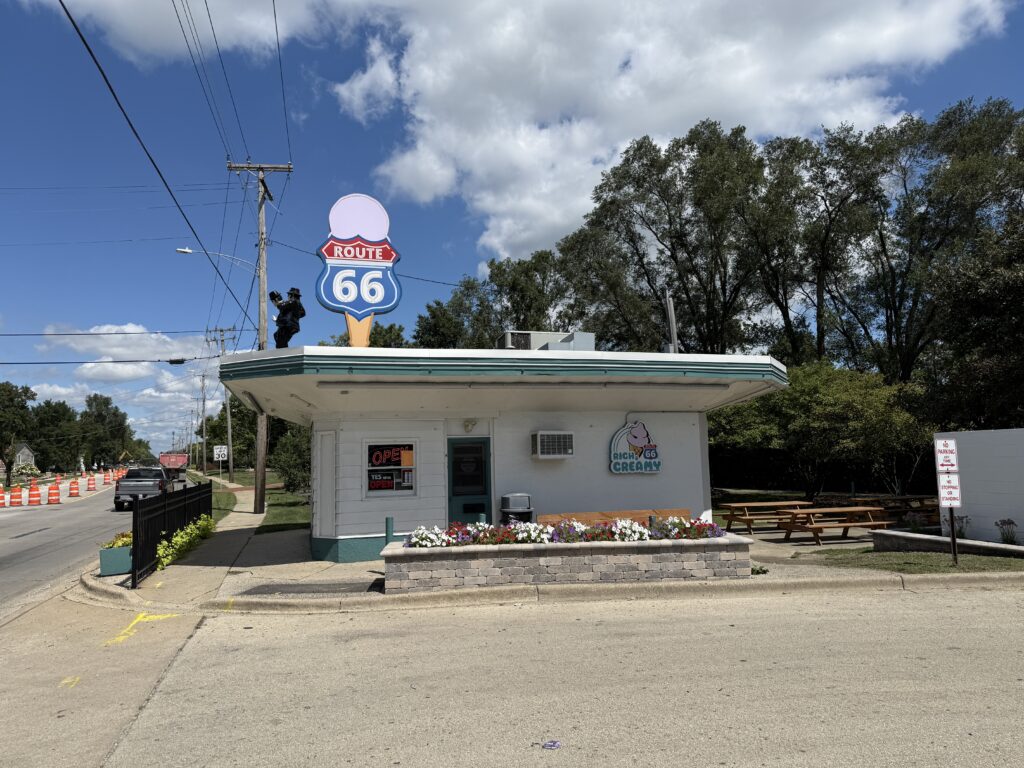
Classic diners and preserved roadside architecture in Joliet capture the look and feel of early automobile travel. These stops reflect how Route 66 quickly became intertwined with everyday life.

Rich & Creamy ice cream stand in Joliet, Illinois, with a large Route 66-themed ice cream cone sign on the roof and Blues Brothers statue figures on top of it
Rich & Creamy’s ice cream cone sign towers over Broadway in Joliet, Illinois. Photo: Dough4872, CC BY-SA 4.0 https://creativecommons.org/licenses/by-sa/4.0, via Wikimedia Commons

A Hollywood Connection

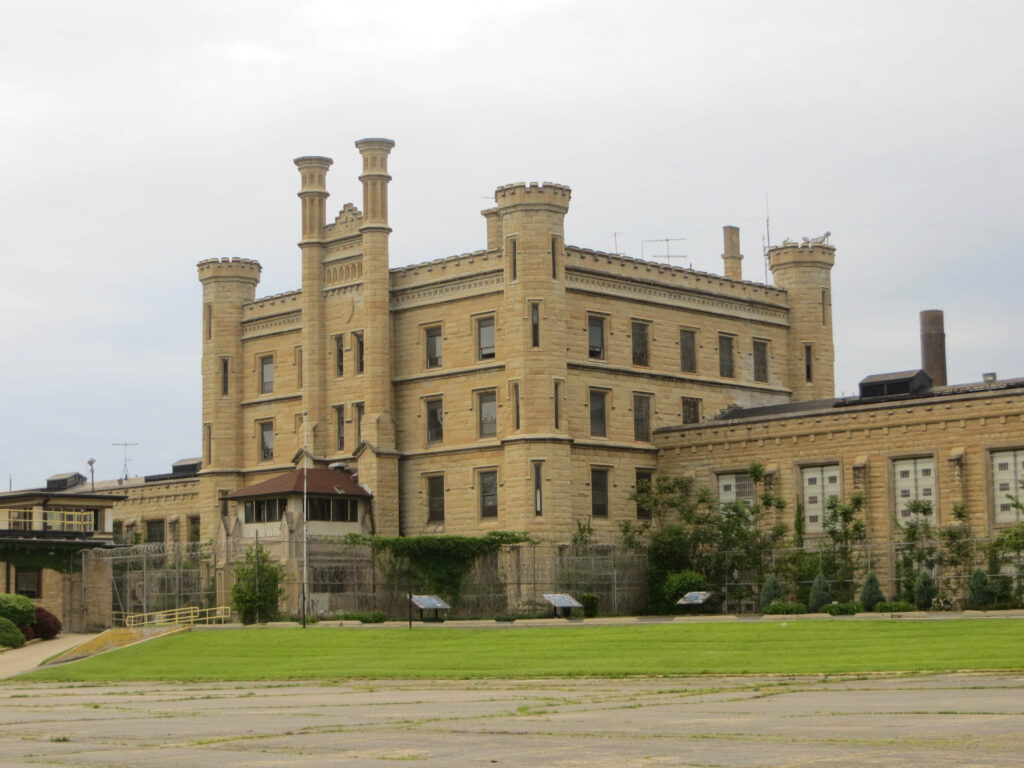
Joliet’s Route 66 fame comes with an unexpected bonus: it’s also the real-life birthplace of “Joliet” Jake Blues. The 1980 cult classic The Blues Brothers opens with Jake, played by John Belushi, walking out of the Joliet Correctional Center after serving three years for armed robbery — the moment his brother Elwood, played by Dan Aykroyd, picks him up and their “mission from God” begins.

The historic Old Joliet Prison's castle-like limestone facade with turrets, arched windows, and razor-wire fencing under an overcast sky
The Old Joliet Prison’s imposing limestone walls have starred in more than one production — including the opening scene of The Blues Brothers and the first two seasons of Prison Break. Photo: David Wilson from Oak Park, Illinois, USA, CC BY 2.0 https://creativecommons.org/licenses/by/2.0, via Wikimedia Commons

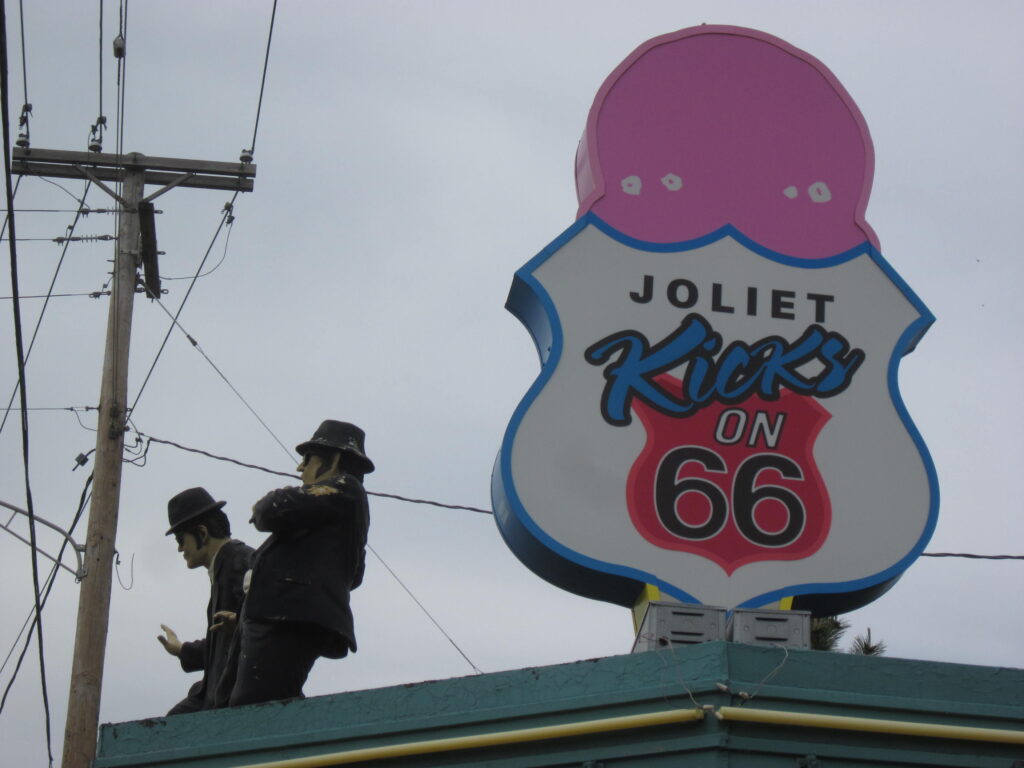
The scene was filmed right at the real prison in August 1979, and at the time, it was still an active maximum-security facility — the production kept such tight security that local newspapers couldn’t even confirm filming was happening. That rooftop tribute atop Rich & Creamy, with two miniature figures in black suits and hats, is a nod to the very same duo.

The prison itself closed in 2002, but it hasn’t faded from memory — it later appeared as the setting for the first two seasons of Prison Break, and fans of The Blues Brothers still gather there for anniversary screenings and events, watching the film play out just steps from where it was actually shot.

Close-up of Blues Brothers figures on a rooftop beside a "Joliet Kicks on 66" ice cream cone sign
Blues Brothers figures keep watch from the rooftop — a nod to Joliet’s most famous movie connection. Photo: Dougtone, CC BY-SA 2.0 https://creativecommons.org/licenses/by-sa/2.0, via Wikimedia Commons

If you’re passing through, it’s worth a short detour off Route 66 to see the limestone walls in person — it’s not every day you can stand in the exact spot where a movie’s opening scene was filmed more than 40 years ago.

Gemini Giant — Wilmington

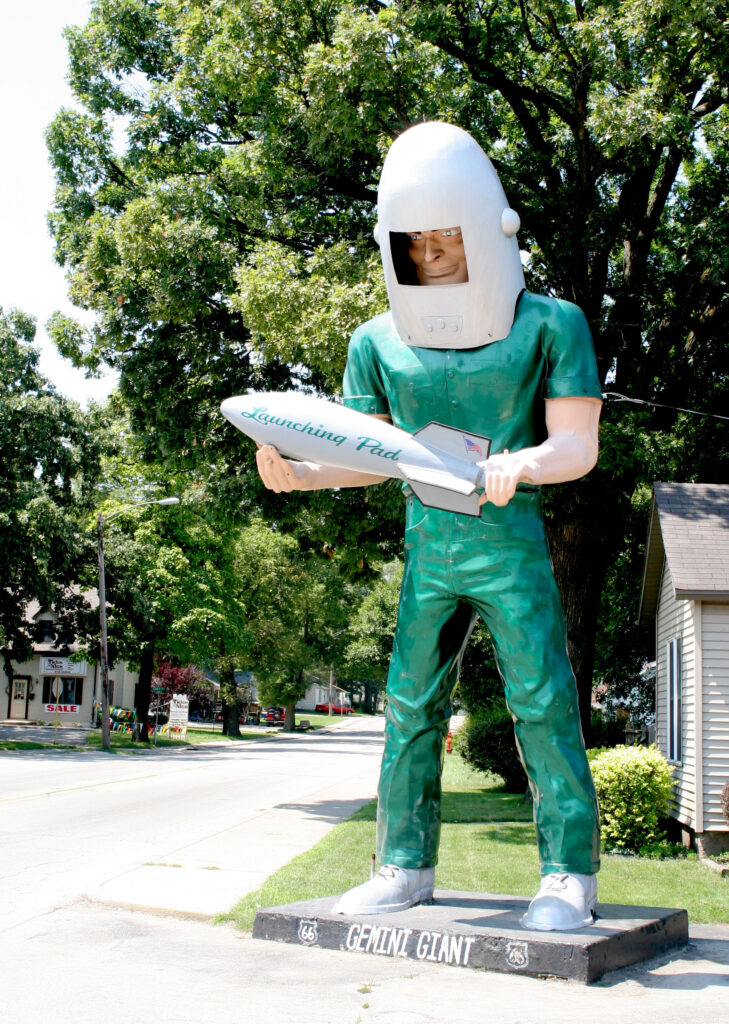
The Gemini Giant, a 28-foot fiberglass astronaut statue in a green jumpsuit and silver helmet, holding a rocket labeled "Launching Pad," standing outside a Route 66 restaurant
The Gemini Giant stood guard outside the Launching Pad from 1965 until 2024. Photo: Original: unknown, Photograph: Studiofox, Public domain, via Wikimedia Commons

Standing 28 feet tall in a green spacesuit with a silver helmet and a rocket cradled in his arms, the Gemini Giant is one of the last of his kind. He started life in 1965 as an ordinary “Muffler Man” — a mass-produced fiberglass figure originally meant to stand outside tire shops — before John and Bernice Korelc bought one for their newly renamed Launching Pad restaurant and had it customized into an astronaut, capitalizing on the country’s fascination with the Space Race. A naming contest at a local grade school settled the rest: a fifth grader’s suggestion of “Gemini Giant,” after NASA’s Gemini program, won out.

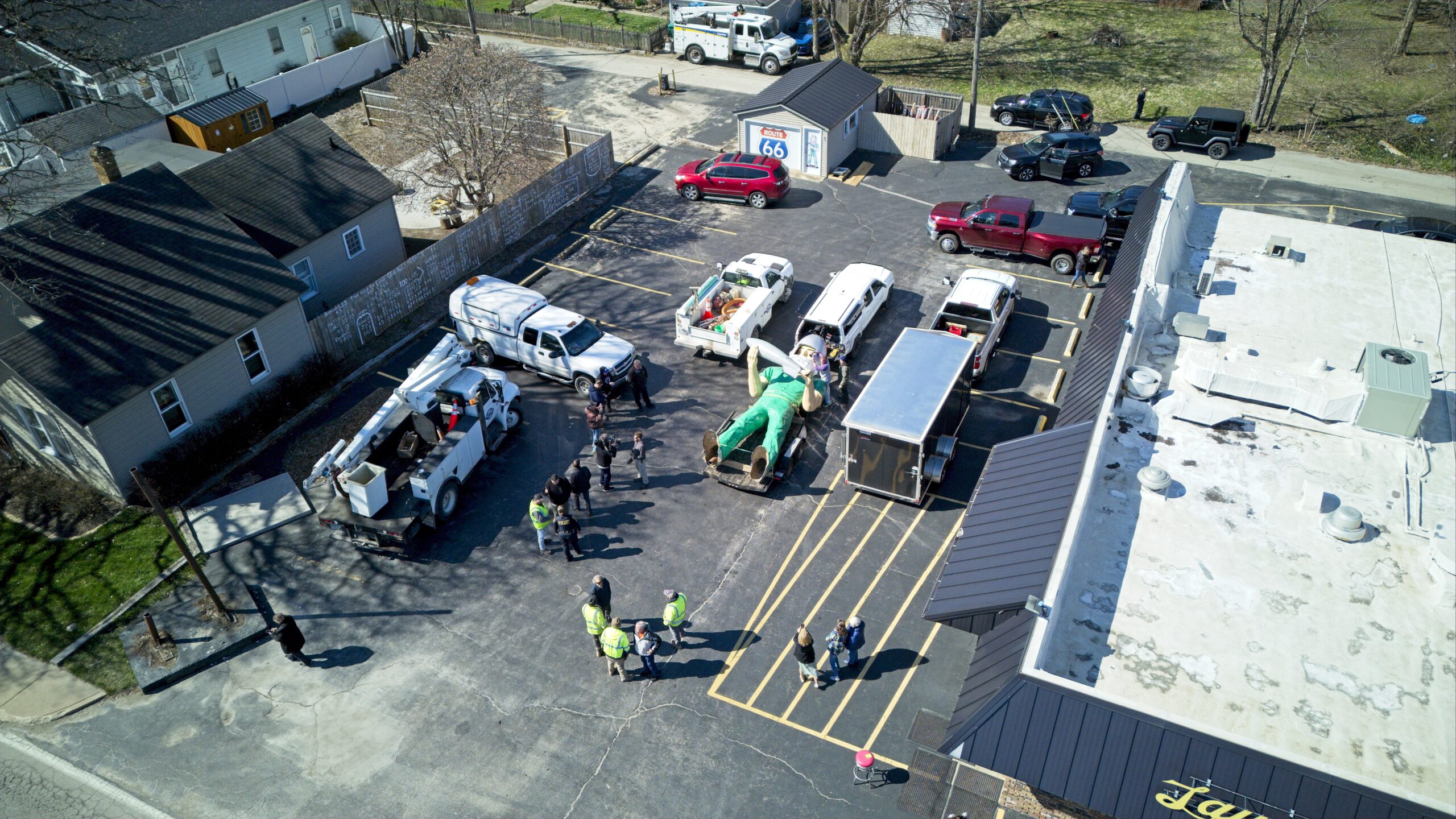
Aerial view of the Gemini Giant statue lying on its back on a flatbed trailer in a parking lot, surrounded by work crews and vehicles during its relocation
The Gemini Gian on a trailer during his 2024 move to a new home at South Island Park. Photo: David Quigley, CC BY 4.0 https://creativecommons.org/licenses/by/4.0, via Wikimedia Commons

For decades, he stood watch outside the Launching Pad, surviving the decline of Route 66 itself and becoming one of the most photographed roadside attractions on the entire route. But when the restaurant finally closed for good and went up for auction in 2024, the Giant’s fate became genuinely uncertain — the auction listing came with a threat that he’d be scrapped if bidding didn’t clear $100,000. He sold for $275,000, purchased by the Joliet Area Historical Museum, the same museum behind that Blues Brothers rooftop tribute back in Joliet. They restored him and gave him a new, permanent home at South Island Park in Wilmington, where he was unveiled again in November 2024 — safe, but no longer standing where generations of Route 66 travelers first found him.

Historic Route 66 Stop & Architecture — Dwight

West of Wilmington and its towering spaceman, the road settles back into quiet farmland before delivering you to Dwight — a town that feels like Route 66 forgot to let go of it. It’s easy to blink past on the drive west from Chicago, but slow down and this small Livingston County village holds onto its stretch of the Mother Road better than almost anywhere else in the state.

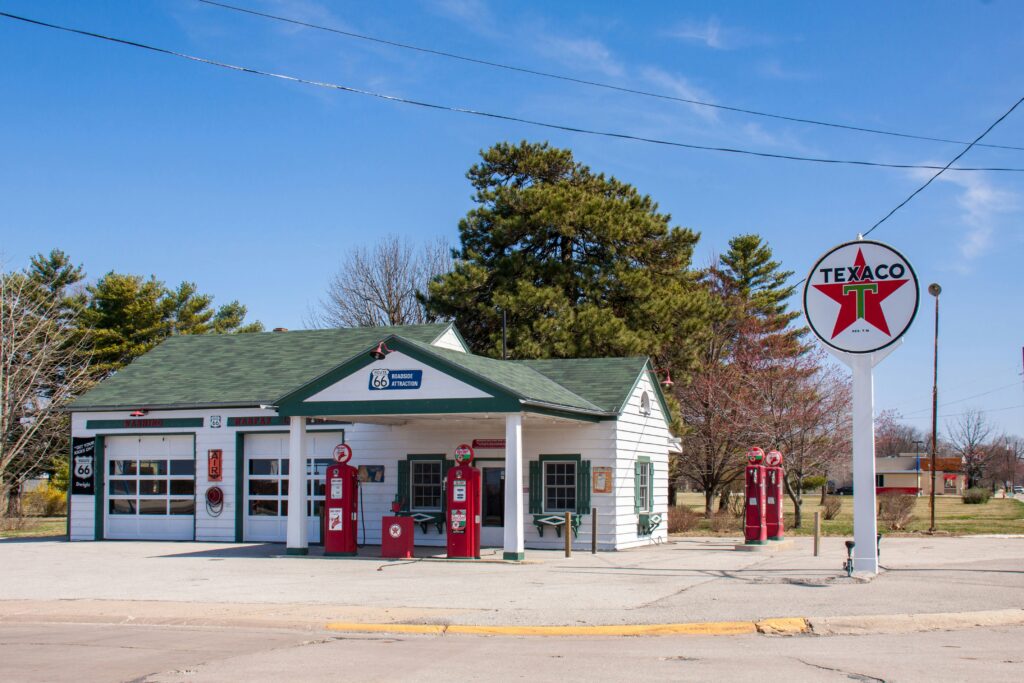
Start at Ambler’s Texaco Gas Station, one of the oldest surviving service stations on the entire route. Built in 1933, it pumped gas for travelers for over 60 years before finally closing in 1998. It’s since been restored and now serves as a visitor and information center — a fitting second life for a building that spent decades welcoming road-trippers exactly like you.

Ambler’s Texaco Station in Dwight has served travelers since 1933. Photo by Jorge Segovia on Unsplash

Right on the property, you’ll also find one of Illinois’s Route 66 Experience Hubs — a nine-foot kiosk with panels covering local history, trivia, and a map of the surrounding attractions. It’s a small stop, but a genuinely useful one if you’re plotting the rest of your drive west toward Odell.

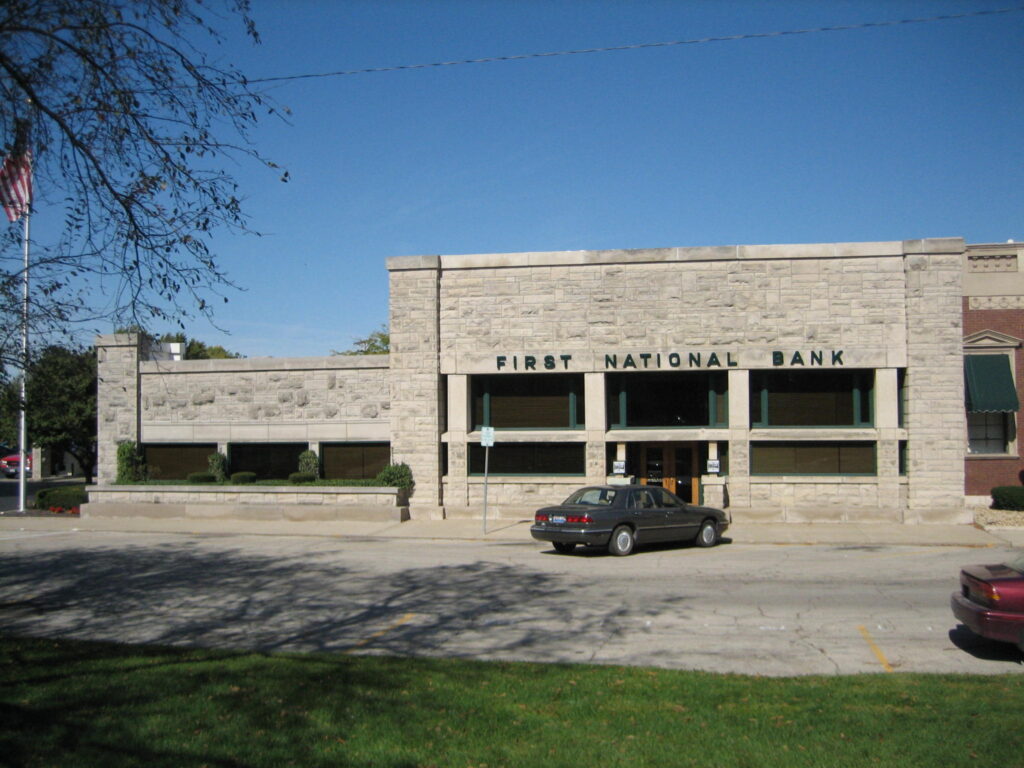
A short walk away stands the First National Bank of Dwight, designed in 1905 by a young architect named Frank Lloyd Wright, decades before he became a household name. The outside is understated by his standards, but it’s still worth a look for anyone tracing his early work.

The First National Bank of Dwight, a low limestone building with the bank's name carved above the entrance, designed by Frank Lloyd Wright
The First National Bank of Dwight, designed by a young Frank Lloyd Wright in 1905. Photo: IvoShandor, CC BY-SA 3.0 http://creativecommons.org/licenses/by-sa/3.0/, via Wikimedia Commons

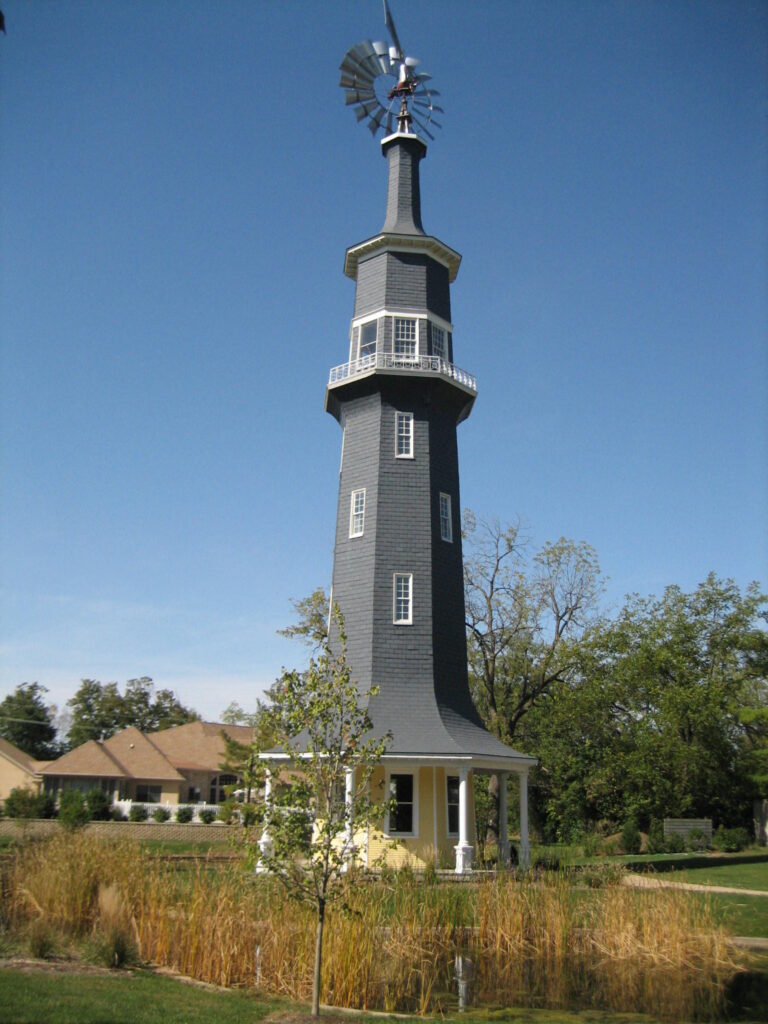
Then there’s the windmill — an eight-sided, five-story tower built in 1896, standing on the grounds of the old Oughton Estate. It wasn’t built for decoration; it once pumped water from a well 840 feet deep for the estate above. That estate has a strange history of its own: it was part of the Keeley Institute, a once world-famous clinic where Dr. Leslie Keeley treated alcoholism as a disease at a time when few others did. Wealthy patients traveled from across the country for his controversial “Gold Cure,” and Dwight briefly became something of a destination in its own right, long before Route 66 ever ran through it.

he historic eight-sided Dwight windmill in Illinois, built in 1896 on the Oughton Estate, with its metal windmill head against a blue sky
The historic Dwight windmill has stood since 1896 — a National Register landmark and one of Illinois’s most distinctive Route 66 stops. Photo: IvoShandor, CC BY-SA 3.0 http://creativecommons.org/licenses/by-sa/3.0/, via Wikimedia Commons

Today, the windmill belongs to the Village of Dwight, donated by a later owner to keep it from decaying. It still turns quietly beside a small pond, a five-story reminder that this town’s story didn’t start with the highway — the highway just happened to run past it.

Route 66 Association Hall of Fame & Museum — Pontiac

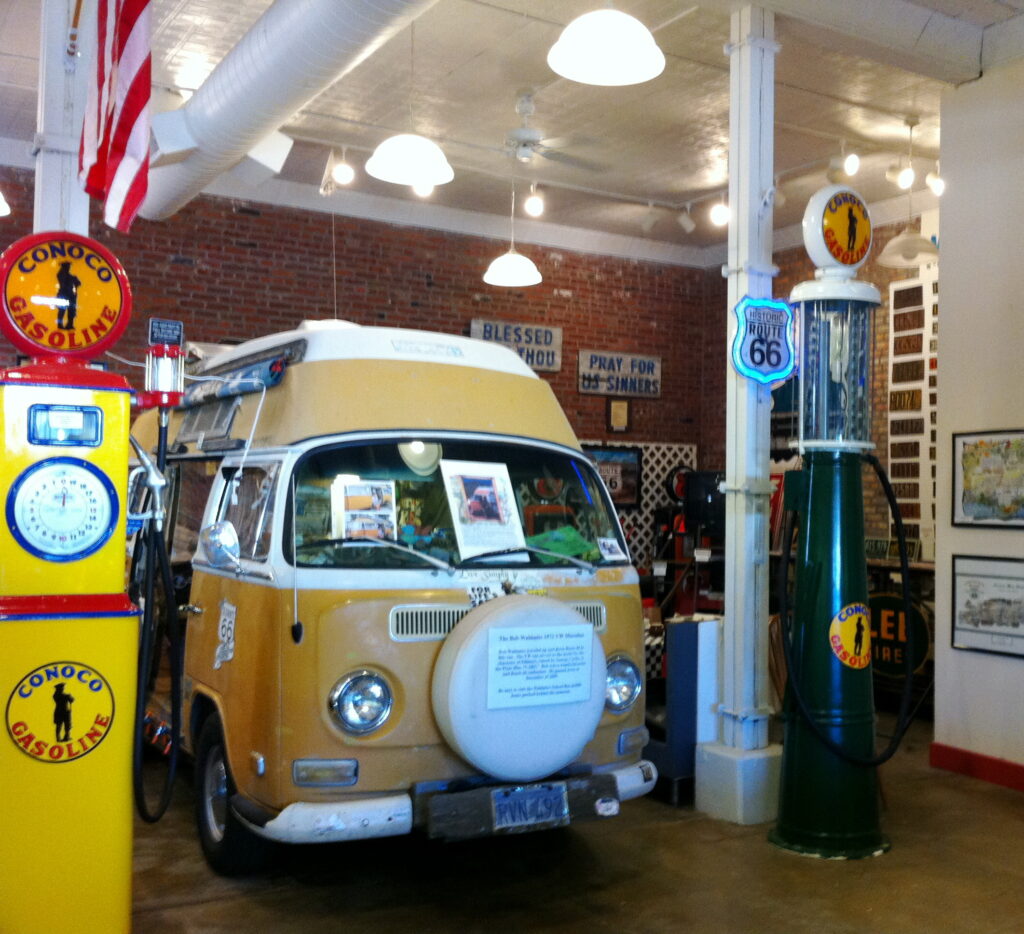
Bob Waldmire's yellow and white 1972 VW Microbus on display inside the Route 66 Hall of Fame and Museum, surrounded by vintage gas pumps and Route 66 memorabilia
Bob Waldmire’s 1972 VW Microbus on permanent display – Route 66 Hall of Fame and Museum. Photo: Anna Harris, CC BY-SA 2.0 https://creativecommons.org/licenses/by-sa/2.0, via Wikimedia Commons

Pontiac serves as one of the strongest Route 66 anchors in Illinois. The Route 66 museum, celebrates the road’s legacy with memorabilia such as the VW bus owned by Bob Waldmire, the artist whose Route 66 drawings (and VW bus) inspired the character Fillmore in Pixar’s Cars

Pontiac Murals

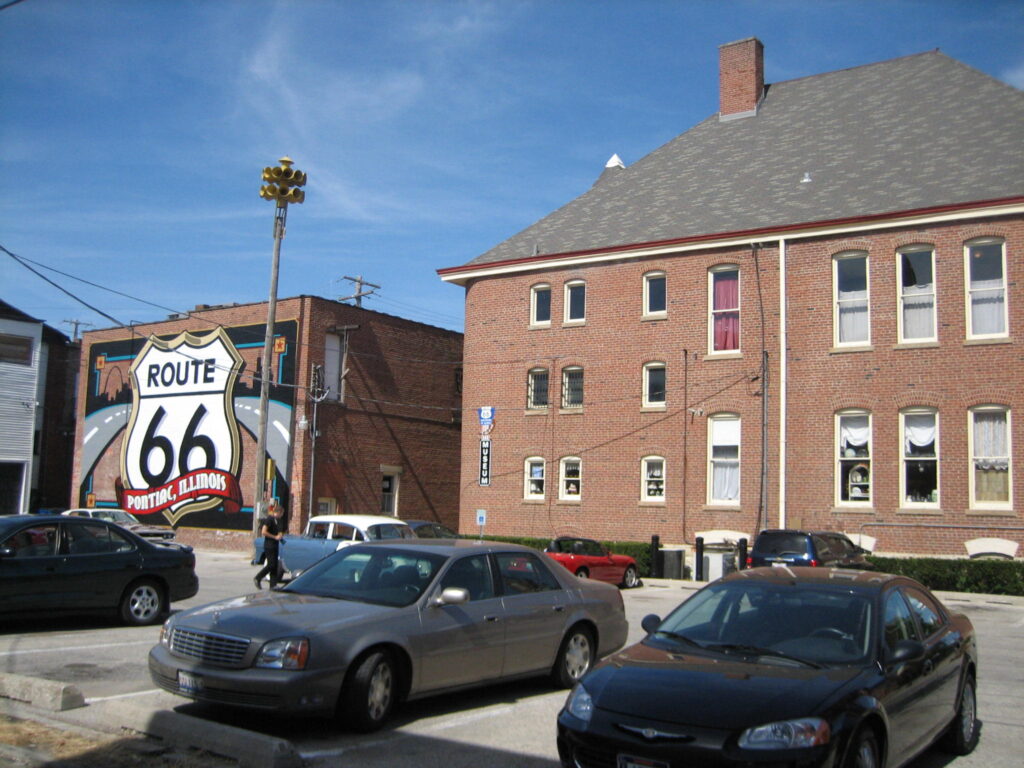
Spread across building walls, Pontiac’s murals tell stories connected to Route 66 culture, automotive history, and local life. Walking through downtown becomes part of the experience rather than a single point of interest.

A Route 66 mural reading "Pontiac, Illinois" on a brick wall, with the historic Pontiac City Hall and Fire Station building visible nearby
The Route 66 mural on Main Street sits just steps from the former Pontiac City Hall and Fire Station, now home to the Route 66 Hall of Fame and Museum — itself listed on the National Register of Historic Places. Photo: IvoShandor, CC BY-SA 3.0 http://creativecommons.org/licenses/by-sa/3.0/, via Wikimedia Commons

Pontiac Historic Downtown

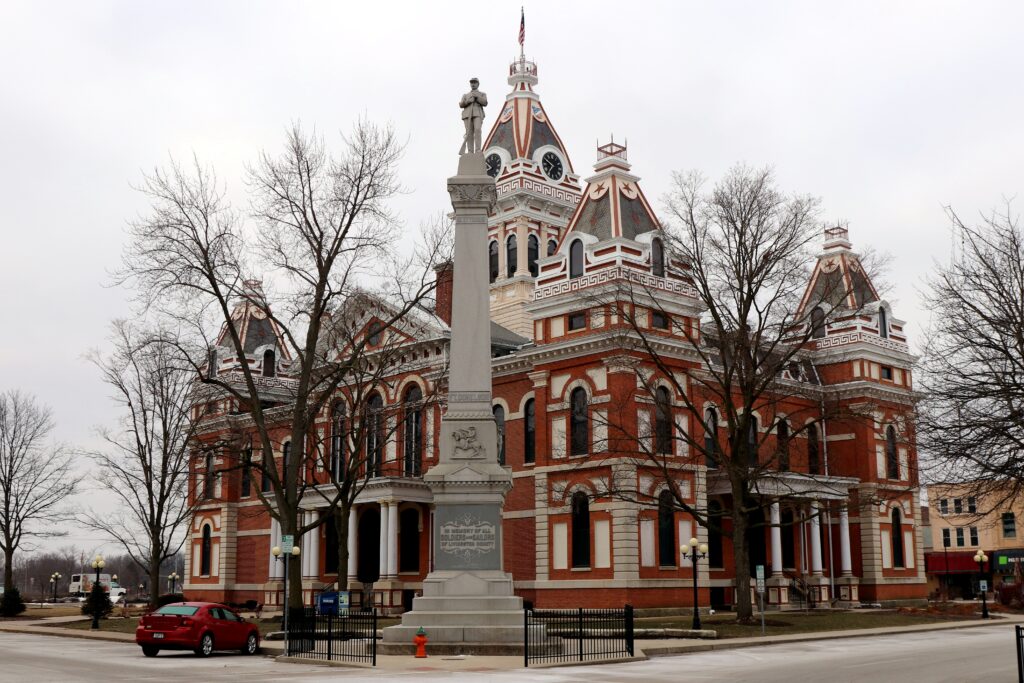
The ornate red brick and limestone Livingston County Courthouse with a clock tower and mansard roofs, framed by bare trees and a Civil War soldier memorial statue
The Livingston County Courthouse has anchored Pontiac’s town square since 1875, its Civil War memorial standing watch out front. Photo: Thank You (25 Millions) views from Fresno, USA, CC BY 2.0 https://creativecommons.org/licenses/by/2.0, via Wikimedia Commons

Livingston County Courthouse

Rising above Pontiac’s town square, the Livingston County Courthouse has anchored downtown since 1875. It’s the county’s third courthouse — the first two didn’t survive; the second burned down in 1874 in a fire believed to have started from mishandled Fourth of July fireworks, taking a chunk of the downtown business district with it. The current building, designed in the Second Empire style by Chicago architect John C. Cochrane, went up in its place, and a multimillion-dollar renovation in 2013 restored the courtroom and main hallway to their original grandeur. It’s still an active government building today, and it’s listed on the National Register of Historic Places.

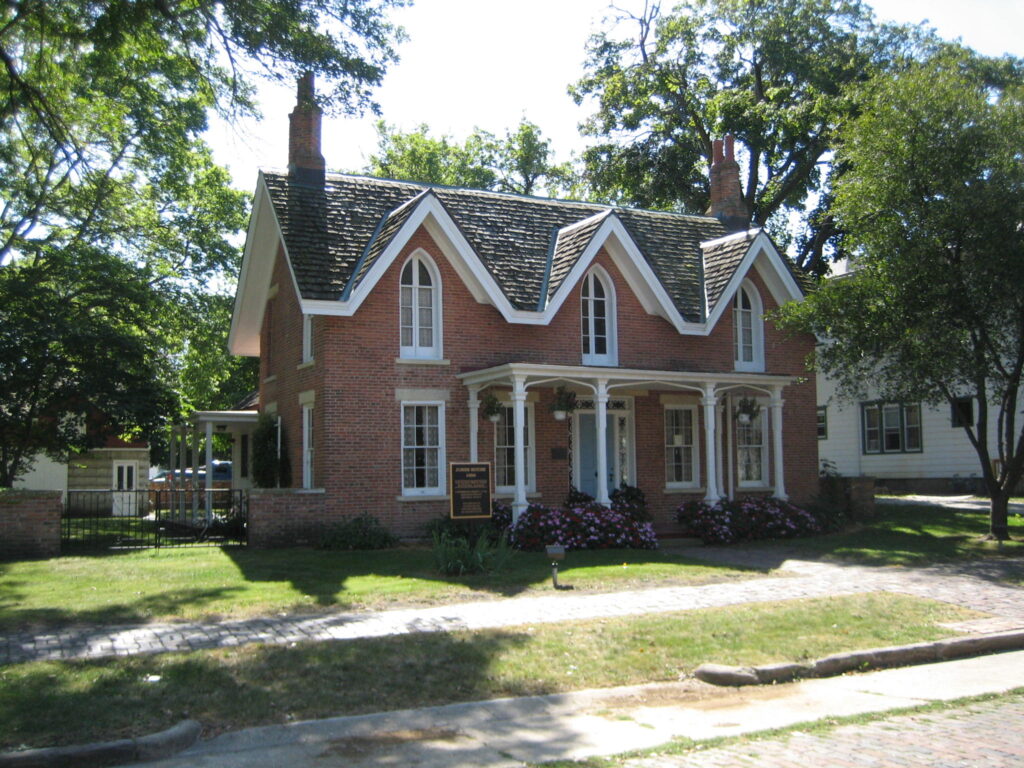
The Jones House, built in 1857–58, is the oldest surviving brick home in Pontiac. Photo: IvoShandor, CC BY-SA 3.0 http://creativecommons.org/licenses/by-sa/3.0/, via Wikimedia Commons

The Jones House

A short walk from the courthouse stands the Jones House, the oldest surviving brick home in Pontiac. Built in 1857–58 in the Gothic Revival style, complete with a steep gabled roof and pointed second-story windows, it takes its name from Henry C. Jones, a newspaper publisher who bought the house in 1899 and lived there with his family for decades. The home came close to being lost — after a fire in 1975, it was slated for demolition before local preservationists stepped in to save it. It’s now owned by the Livingston County Historical Society, restored to reflect the 1860s, and open for public tours on select days each month.

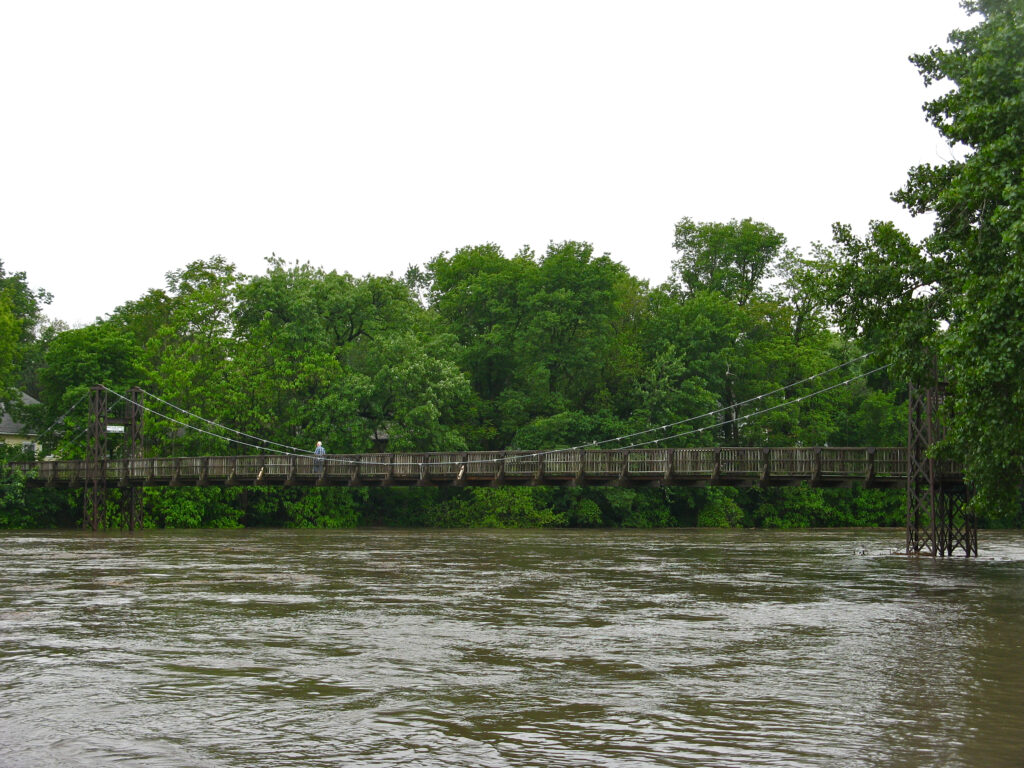
History in Pontiac isn’t only something you look at — some of it, you still get to cross.

A wooden suspension footbridge crossing the wide, murky Vermilion River, with a person walking across and dense trees lining the far bank
One of Pontiac’s three swinging pedestrian bridges spans the Vermilion River — a quiet holdover from the 1890s, still open to walk across today. Photo: hakkun, CC BY-SA 3.0 https://creativecommons.org/licenses/by-sa/3.0, via Wikimedia Commons

The three swinging pedestrian bridges over the Vermilion River — two were built in the 1890s for factory workers to cross the river, and they’re still walkable today. Pontiac is apparently the only town in Illinois with three of these.

Springfield, Illinois

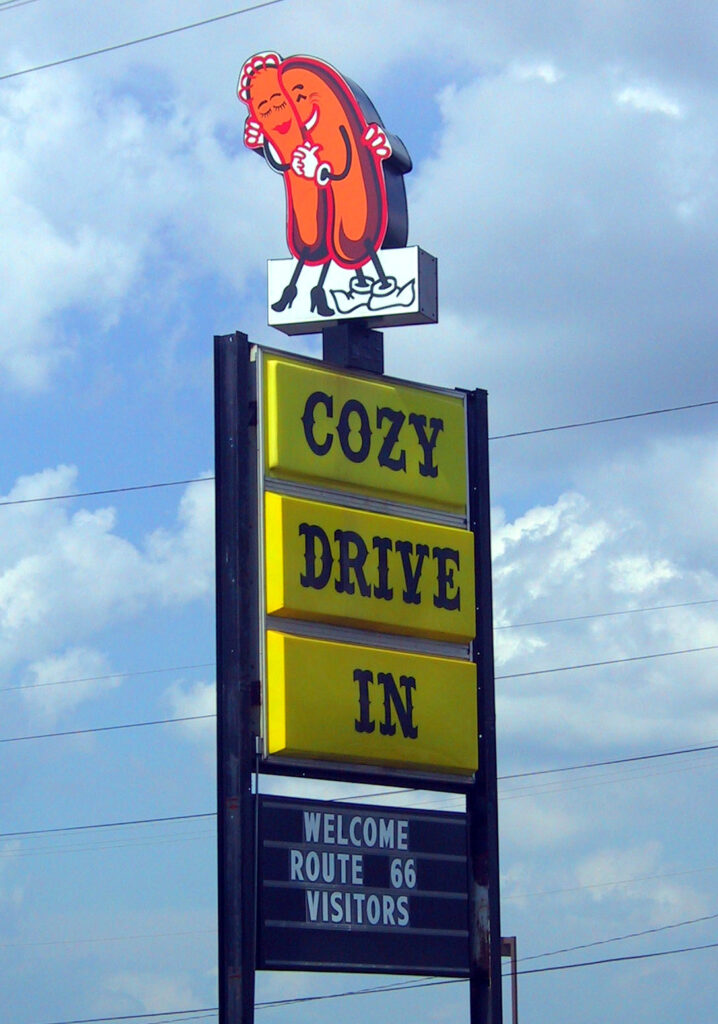
The Cozy Dog Drive-In sign along Route 66, topped with a cartoon logo of two hot dogs embracing, with a marquee reading "Welcome Route 66 Visitors"
A vintage view of the Cozy Dog Drive-In sign, featuring Virginia Waldmire’s original “two hot dogs in love” logo. Photo: National Archives and Records Administration, Public domain, via Wikimedia Commons

If corn dogs on a stick have a birthplace, it’s here. Ed Waldmire Jr. first encountered the idea in the early 1940s — a hot dog baked into cornbread, sold at an Oklahoma diner — but thought it took far too long to make. Stationed in Amarillo during World War II, he perfected a batter recipe that could be dipped and deep-fried in minutes instead, and started selling his creation at the base PX under the name “Crusty Curs.” His wife Virginia understandably vetoed that name, and by the time the couple brought the recipe home to Springfield in 1946, “Cozy Dog” had stuck instead — along with her hand-drawn logo of two hot dogs in a loving embrace.

The stand-alone Cozy Dog Drive-In opened along Route 66 in 1949, and the business has stayed in the Waldmire family ever since, now run by Ed’s grandson Josh. The batter recipe hasn’t changed since 1946, and neither has the attitude: order a “corn dog” here, and you may get a polite correction. This is the original.

There’s also a Route 66 connection running through the family beyond the food itself. Ed and Virginia’s son, Bob Waldmire, was a Route 66 artist and mapmaker who spent years traveling the road in a customized 1966 school bus — the same “Road Yacht” now displayed at the Route 66 Hall of Fame and Museum in Pontiac.
Roadside Culture & Landmarks

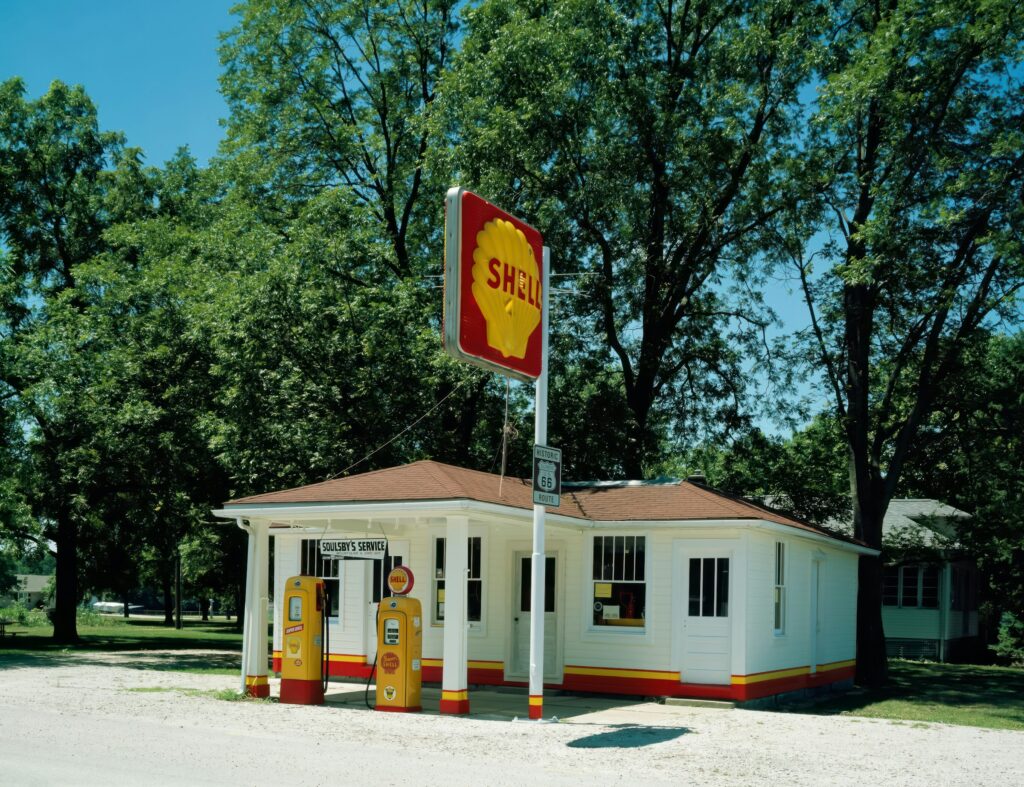
Illinois’ Route 66 culture is less about novelty and more about preservation. Early diners, service stations, and signage appear in context rather than isolation, reinforcing the sense that Route 66 grew organically as people responded to the needs of travelers passing through.

Vintage Shell station on Route 66 in Mount Olive, Illinois., Built in 1926. Photo credit Carol Highsmith’s America on unsplash.com

Traveling Through Illinois

Traveling Route 66 in Illinois often means navigating urban streets and short highway segments rather than long, uninterrupted drives. This makes it easy to explore towns slowly, with frequent opportunities to stop, walk, and revisit places tied closely to the origins of the route.

Time of day and traffic patterns can shape the experience, especially near Chicago, but the density of sites also makes this stretch approachable for shorter trips.

Murals, museums, and restored buildings serve as reminders that Route 66 in Illinois is not frozen in time—it’s actively remembered and maintained.

Want the full 8-state guide?  Download it free.