Devils Tower — America’s first national monument, and still one of its most striking
Devils Tower has been a favorite of mine for a long time, and it felt right to start our National Monuments and Historic Sites collection here — not just because of the history, but because nothing I’d seen in photos prepared me for actually standing at the base of it.
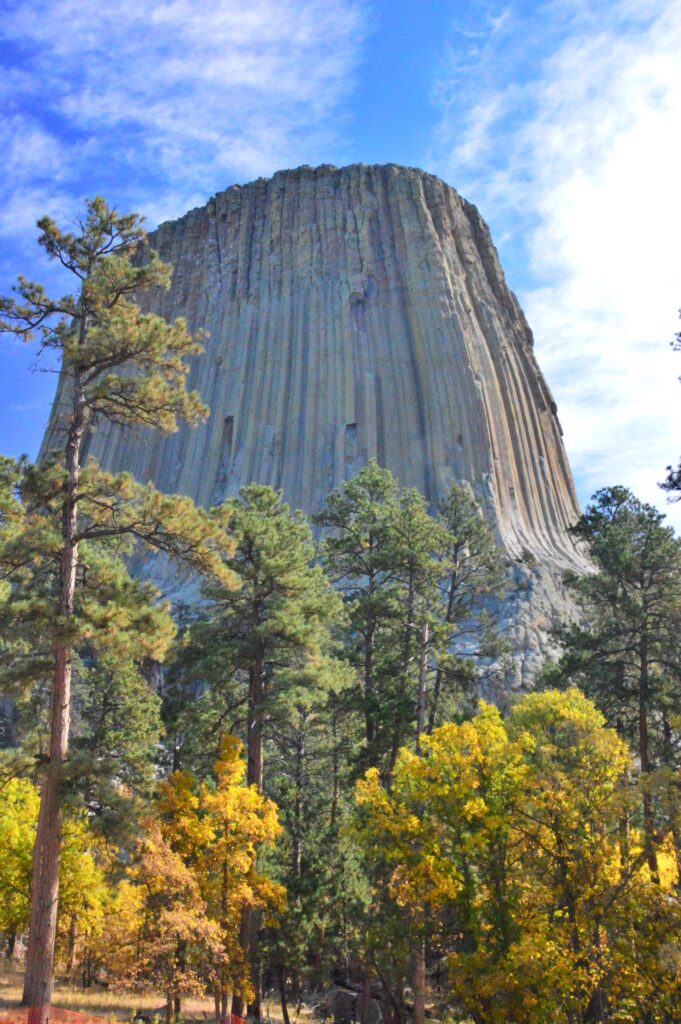
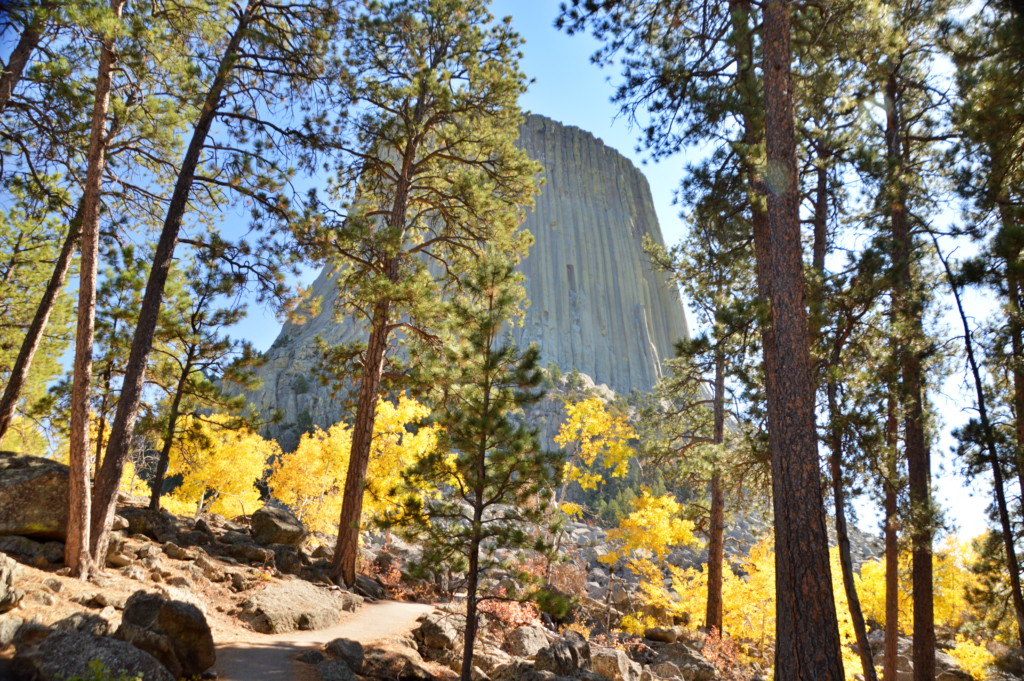
Nothing quite prepares you for standing at the base and looking up at this.
We visited in the fall, on a day trip out from the Black Hills, where we’d been based while checking off Mount Rushmore and the Badlands. Devils Tower wasn’t originally on our radar — I’d honestly never heard of it — but a few people we talked to along the way insisted it was a must-see, so we made the trip, and we’re so glad that we did.
The weather cooperated beautifully: crisp and cool without being cold, with the aspens and cottonwoods around the tower blazing gold and orange. It turned out to be one of the best last-minute decisions of the whole trip.
America’s First National Monument
Devils Tower earned a genuine first in American history: on September 24, 1906, President Theodore Roosevelt designated it as the nation’s very first national monument, using powers Congress had just granted him that same year under the Antiquities Act. Nothing else in the country carries that particular distinction — every other national monument that followed, followed this one.
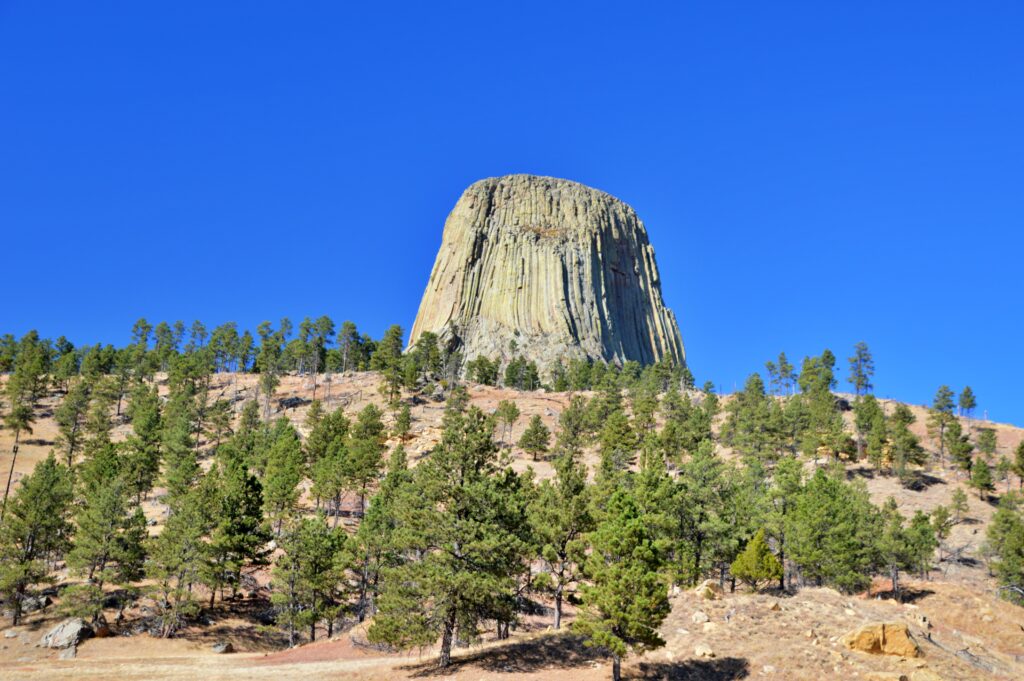
Devils Tower rises abruptly from the surrounding hills — a sight that will stop you in your tracks.
The tower itself rises 1,267 feet above the Belle Fourche River, with its summit standing 867 feet above its own base. Geologists believe it formed around 65 million years ago, when molten rock pushed up into existing sedimentary layers and cooled underground into columns — the same process that created the tower’s famous vertical cracks, as the cooling rock contracted and split. Millions of years of erosion eventually wore away the softer rock that once surrounded it, leaving the hard igneous core standing alone on the plains, visible from more than 30 miles away along I-90.
When the 1906 proclamation was published, the apostrophe was accidentally dropped from “Devil’s,” and it was never officially corrected. So the missing apostrophe you see everywhere — Devils Tower, not Devil’s Tower — is a 120-year-old typo that became permanent.
Bear Lodge: A Sacred Site
Long before it was Devils Tower, it was Bear Lodge — and to more than 20 Native American tribes, including the Lakota, Cheyenne, Crow, Arapaho, and Kiowa, it still is.
The name “Devils Tower” itself came from a mistranslation: in 1875, an interpreter on an Army expedition rendered a native name as “Bad God’s Tower,” which was later shortened and hardened into the name that stuck. Since 2005, tribal members have formally petitioned to have the site renamed Bear Lodge National Historic Landmark, though the change has not yet moved forward in Congress.
Multiple tribal legends explain the tower’s origin, and most center on the same core story: a group of young girls being chased by a giant bear climb onto a small rock and pray for safety, and the rock rises beneath them, carrying them up out of the bear’s reach. As the bear claws at the rising rock trying to reach them, it leaves the deep, parallel grooves you can still see running up the tower’s sides today — what geologists explain as columnar jointing, and what the story explains as claw marks. In some versions, the girls reach the sky and become the stars of the Pleiades.
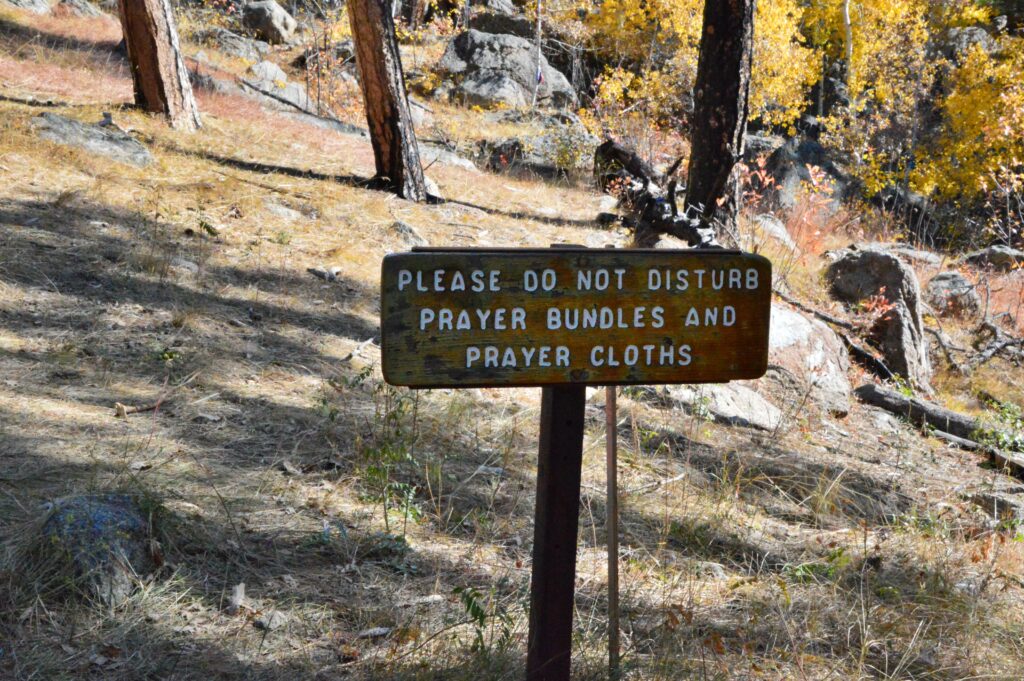
A quiet reminder along the trail: these prayer bundles and cloths are part of active spiritual practice.
This is genuinely still a living sacred site, not a historical footnote. As you walk the trail around the base, you’ll see small bundles of cloth tied to the branches of the surrounding trees — prayer cloths, left by Native visitors as part of ongoing spiritual practice. Signs around the monument ask visitors not to disturb them, and it’s worth taking that seriously; these aren’t decorations or souvenirs, they’re active prayers.
Every June, tribes gather at the tower for ceremonies tied to that time of year, and since 1995 the National Park Service has asked climbers to voluntarily avoid climbing during that month out of respect. It isn’t an enforced closure — climbers are still legally allowed to climb in June if they choose — but the vast majority honor the request, and climbing activity drops off noticeably that month as a result.
What struck me most wasn’t the cloths tied to the trailside trees at ground level — it was looking up and spotting a few tied to scrawny trees partway up the tower itself, well above where anyone could reach without doing some real climbing. Whoever placed them had to partially scale the rock just to leave them there.
It says something about how seriously this practice is taken, and it’s a small, striking reminder that this place means something far deeper to some visitors than a scenic overlook.
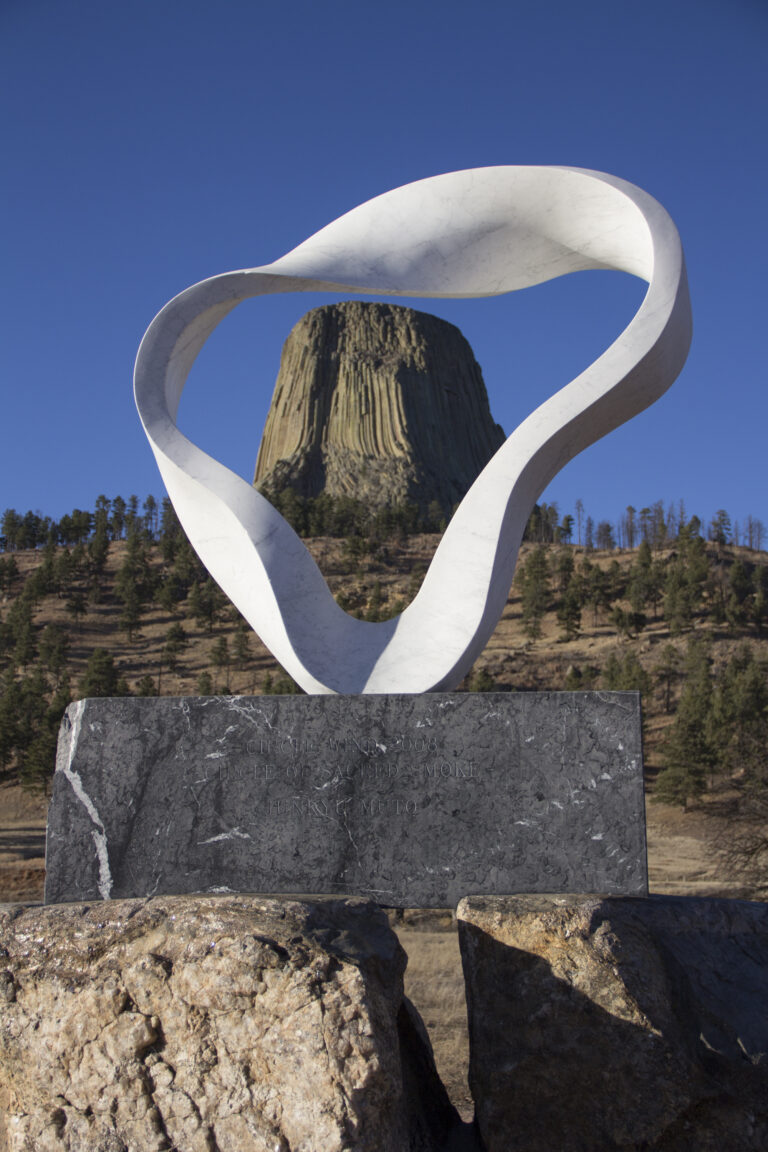
Circle of Sacred Smoke, a 2008 sculpture by Junkyu Muto honoring the tower’s significance to more than twenty affiliated tribes. (Photo: NPS / Avery Locklear)
Not far from the prairie dog town, a marble sculpture called Circle of Sacred Smoke stands facing the tower — a modern gesture built on the same respect. Created by Japanese sculptor Junkyu Muto and installed in 2008, the sculpture represents the first curl of smoke rising from a newly lit pipe, and it was made specifically to honor the tower’s significance to more than twenty affiliated tribes, as a gesture of world peace.
It’s the third of seven planned sculptures Muto is placing around the world — the first two stand at the Vatican and at Bodh Gaya, India, one of Buddhism’s holiest sites.
Framed just right, the sculpture’s open curve lines up perfectly with the tower rising behind it, which feels like exactly the point.
The Tower Trail
We walked the Tower Trail, a 1.3-mile paved loop that circles the entire base of the monument. It’s an easy, mostly flat walk, but don’t let that fool you into rushing it.
The trail changes character as you go, moving through pine forest and boulder fields, with the tower looming differently from every angle.
The Tower Trail shifts constantly as you walk it — pine forest, boulder fields, and the tower looming a little differently with every turn.
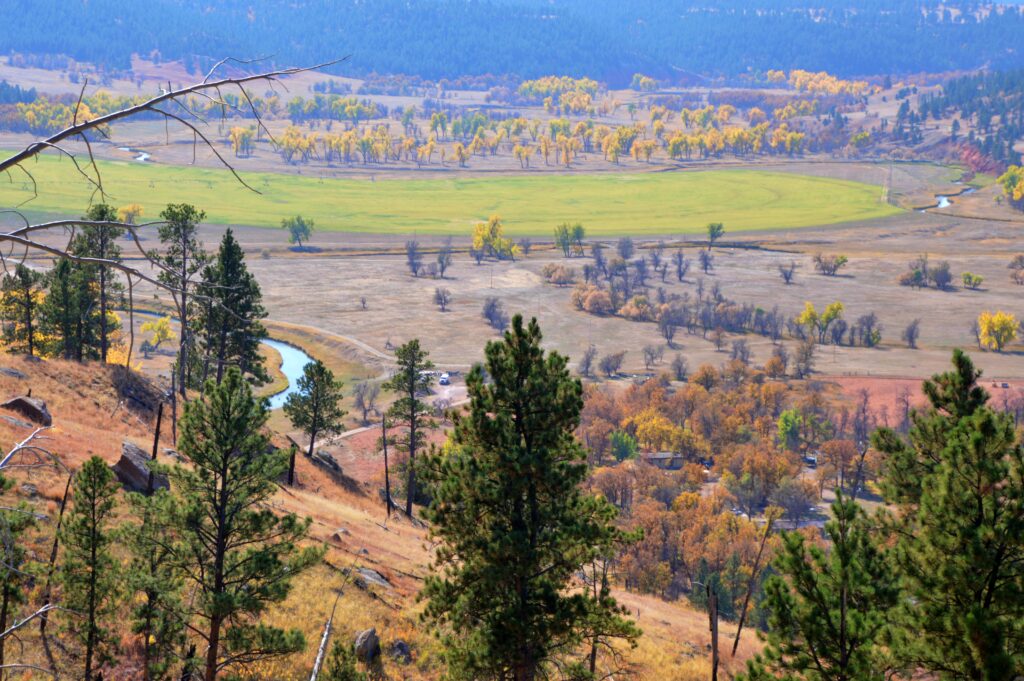
On the back side of the trail, the view opens up entirely — instead of columns of rock overhead, you’re looking out over the Belle Fourche River winding through the valley below, ranchland and cottonwoods stretching out in every direction.
The back side of the Tower Trail trades columns of rock for wide views of the Belle Fourche River valley.
We happened to catch it in fall color, and it was a genuinely nice surprise to turn a corner on the trail and find a totally different kind of view waiting.
The Ladder, the Ranchers, and the Parachutist
Long before modern climbers were working their way up the tower’s cracks with ropes and cams, two local ranchers beat them to the summit using nothing but oak stakes and stubbornness.
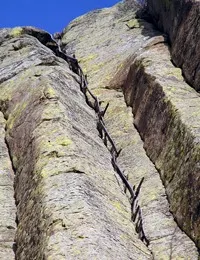
In the spring of 1893, William Rogers and Willard Ripley spent weeks building a 350-foot wooden ladder straight up a crack on the tower’s southeast face — driving stakes into the rock and bracing them with planks, one section at a time, with Ripley reportedly doing much of the work while suspended from a pulley system.
They built it for a reason: on July 4, 1893, Rogers climbed it publicly as part of an Independence Day celebration, and it worked exactly as planned. Word had traveled for weeks beforehand, and somewhere between 800 and 1,000 spectators — some having traveled up to 100 miles by horse and wagon — gathered at the base to watch. Rogers made the climb in about an hour, reached the top, and ran an American flag up a pole he and Ripley had already planted there in advance. The crowd, by all accounts, went wild.
The ladder didn’t stop being useful after that first climb. Two years later, in 1895, Rogers’s wife Linnie used it to become the first woman to reach the summit — in knee-high boots and bloomers, no less.
Roughly 215 people are recorded to have used the ladder over the following decades, right up until 1927, when it was formally decommissioned. Portions of it are still visible today on the southeast face, and it’s now listed on the National Register of Historic Places in its own right.
Portions of the original 1893 stake ladder are still visible on the tower’s southeast face today. (Photo: National Park Service)
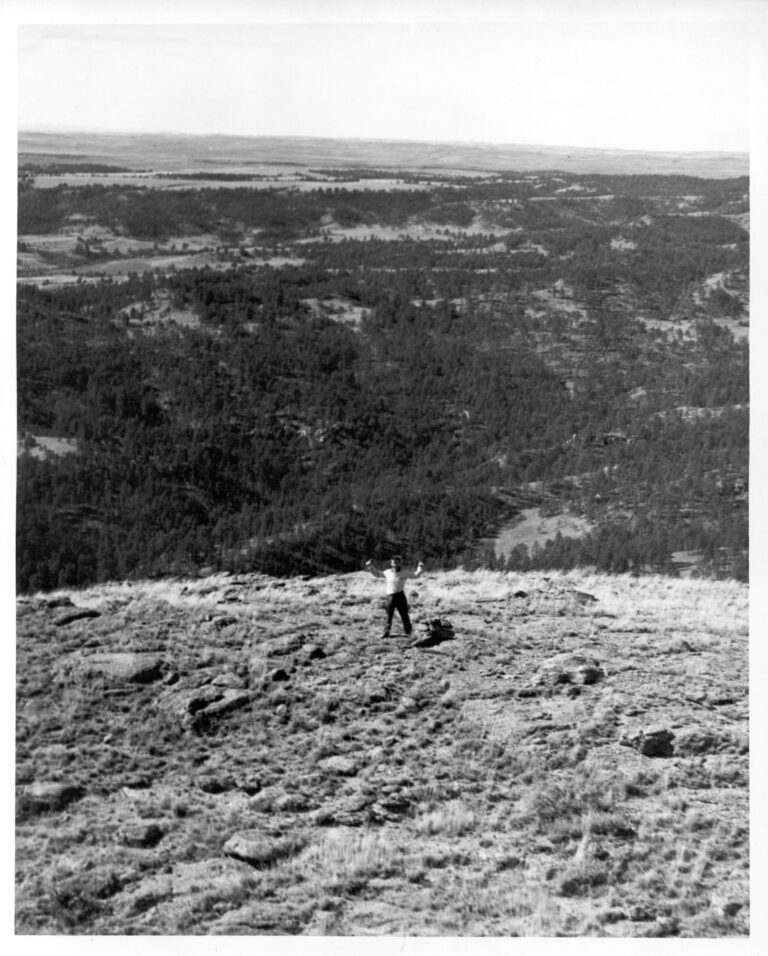
The tower’s most bizarre story, though, belongs to neither a climber nor a rancher. In 1941, a stunt pilot named George Hopkins parachuted onto the summit — intentionally, as a publicity stunt — with a plan to rappel back down using a rope that was supposed to be dropped up to him afterward.
George Hopkins shows his excitement after successfully parachuting to the top of Devils Tower. (Photo credit: NPS)
The plan fell apart. Bad weather and a poorly executed rope drop left Hopkins genuinely stranded on top of the tower for six days, making national news, before a team of experienced climbers finally reached him and brought him down safely. It’s the kind of story that sounds made up, and it’s entirely true.
Climbing The Tower
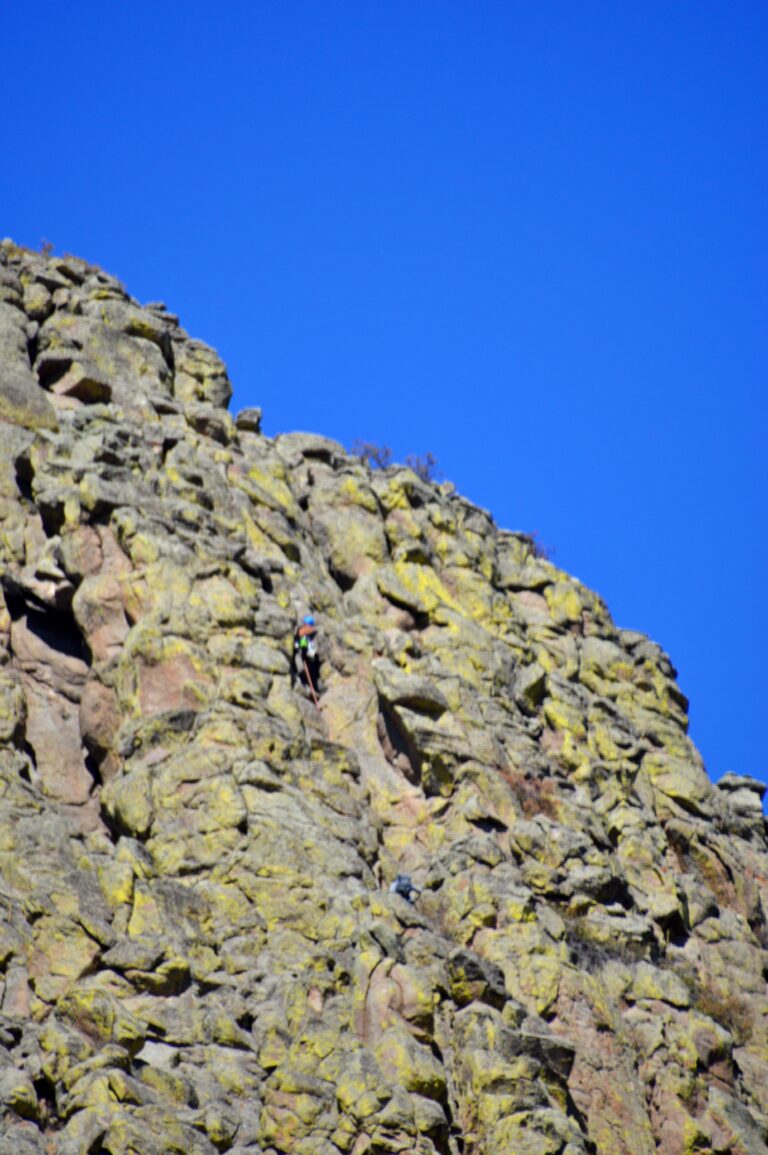
Devils Tower is a world-renowned destination for vertical crack climbing, and its columns — the same ones formed by that ancient cooling and cracking — create some of the most distinctive climbing routes anywhere in the country. Hundreds of established routes run up the tower’s sides, and on the day we visited, we could pick out climbers working their way up the cracks from the trail below.
Two rock climbers ascending a crack on the back side of Two climbers work up a crack on the tower’s back side — one barely visible below the other, both nearly lost against the lichen-covered columns.
On the back side of the tower, we watched two climbers slowly working their way up one of the cracks — patient, deliberate, barely visible against the lichen-covered rock until you knew exactly where to look.
There’s something about the scale of it, a tiny human figure against those massive columns, that really drives home just how big this thing actually is.
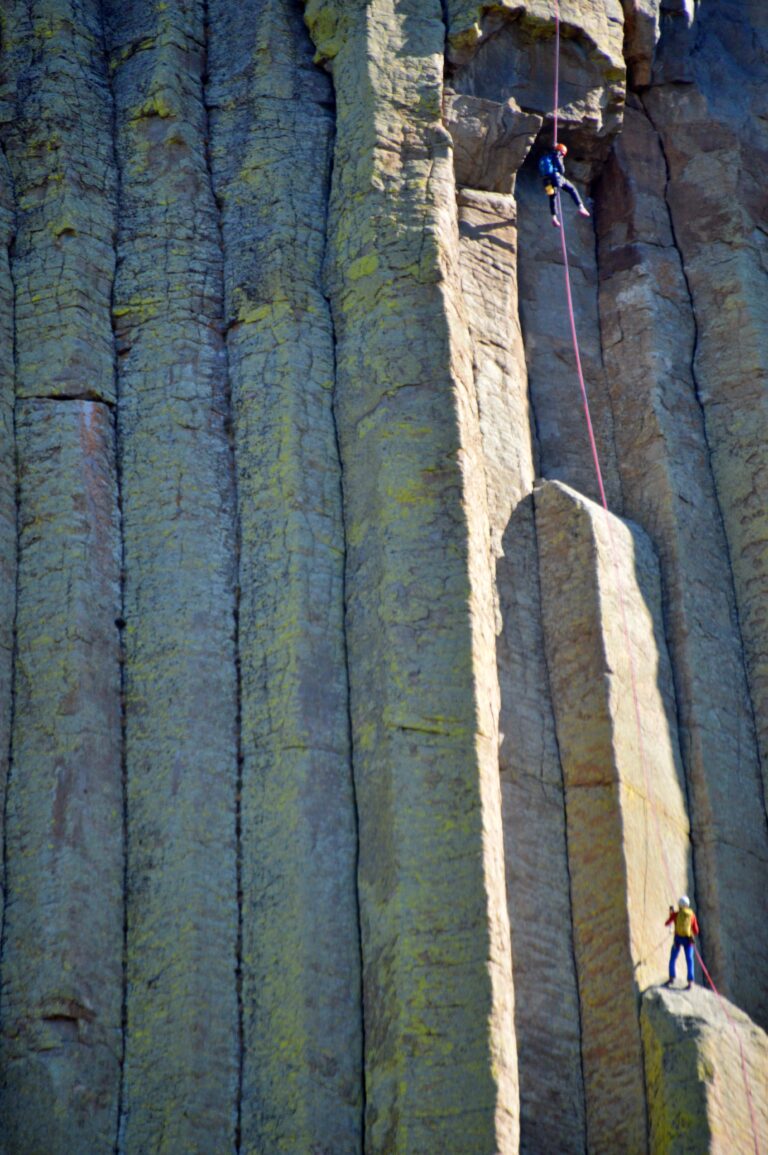
Climbers rappelling down the tower’s front face, watched from below by a small, silent crowd.
Later, on the front side, we ended up standing with a small crowd who’d stopped just to watch a pair of climbers rappel back down. Nobody said much — everyone just tipped their heads back and watched in silence as the climbers descended, rope by rope, past those enormous vertical columns.
I have a feeling my husband, along with every other man standing in that group, was thinking some version of the same thing: I could do that if I wanted to.
The Prairie Dog Town
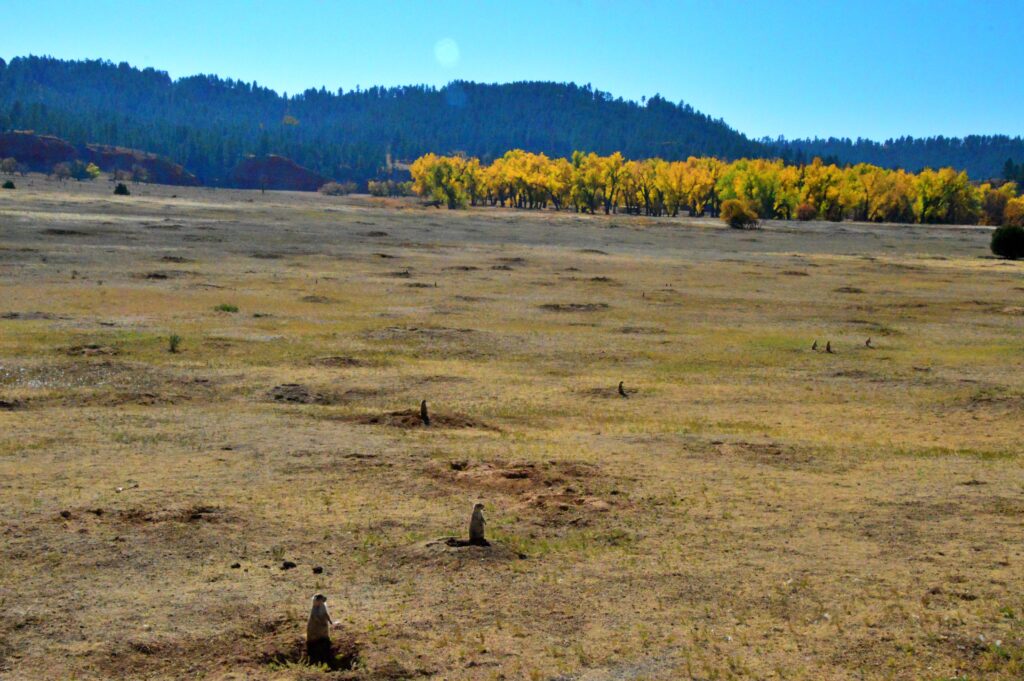
The prairie dog colony stretches out toward a stand of golden cottonwoods, mounds and lookout posts scattered across the grassland.
One of the unexpected highlights of the drive in is the prairie dog town near the entrance road — a sprawling colony you’ll spot before you even reach the tower itself, dotted with little mounds and even littler sentries standing at attention beside their burrows. It’s a nice reminder that this place isn’t just about the tower; the surrounding grasslands have their own busy, thriving ecosystem going on right alongside it.
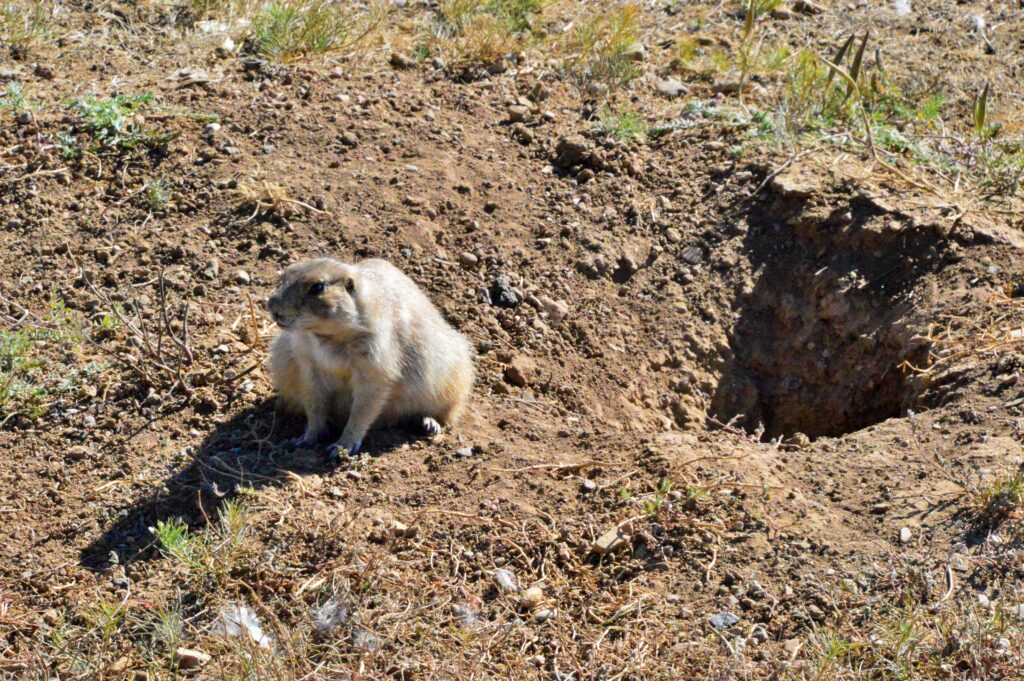
A prairie dog pauses just long enough for a close-up before ducking back to its lookout post.
While I was photographing them, the whole colony suddenly went on alert — the prairie dogs stood bolt upright and started up a chorus of sharp warning calls, passing word down the line.
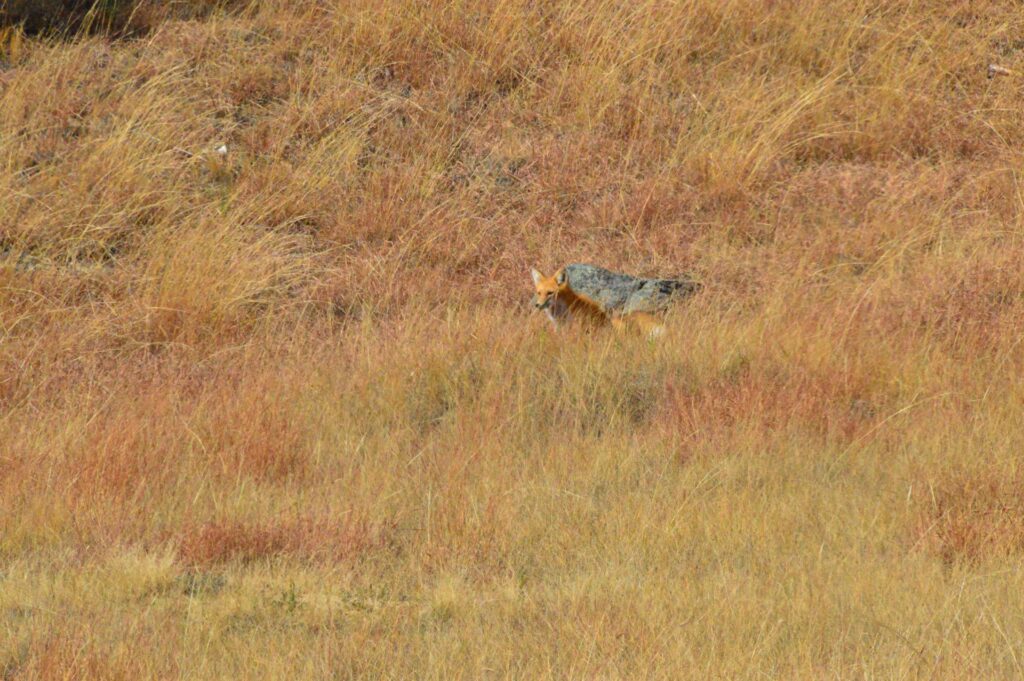
My husband, watching from the truck, spotted the reason before I did: a red fox moving low through the grass in the field right next to the road, clearly hunting.
The fox that set the whole prairie dog colony on high alert, moving low through the grass just off the road.
The prairie dogs had already seen it and were doing exactly what prairie dog colonies are known for — warning each other, burrow by burrow, faster than we could even track the fox ourselves. It was a genuinely wild thing to watch play out in real time, right by the side of the road.
Planning Tips Before You Go
Entrance fees are $25 per private vehicle, $20 per motorcycle, or $15 if entering on foot or bike
The park sees around 500,000 visitors a year, with more than 80% arriving between Memorial Day and Labor Day — visit outside peak summer hours if you can
Parking fills up fast in summer; the lot regularly hits capacity for hours at a time during peak season
The Tower Trail is paved and mostly flat, making it accessible for most fitness levels — budget 45 minutes to an hour if you want to stop and take photos
If you spot prayer cloths or bundles along the trail, leave them undisturbed — they’re part of active, ongoing tribal spiritual practice, not decoration
Watch for climbers on the tower’s north and east faces especially — those routes tend to be more visible from the trail
If you’re hoping to see climbers, avoid June — most climbers voluntarily hold off that month out of respect for tribal ceremonies happening at the tower, so activity on the rock is much lighter
The prairie dog town is right along the entrance road — slow down, and you likely won’t be able to miss it
Devils Tower has stayed one of my favorite stops out of everywhere we’ve been — not because it’s the biggest or the most famous, but because it manages to be so many things at once: a geological oddity, a living sacred site, a climbing destination, and a place with a humorous past. We almost missed it entirely, and I’m endlessly glad we didn’t. If you’re anywhere near the Black Hills — put this one on the list.