The Enchanted Highway:
An Unexpected Stretch
of North Dakota
There are stretches of road where the destination matters. And then there are places where the drive itself becomes the experience.
The Enchanted Highway, in western North Dakota, falls somewhere in between. We drove it on the way to Theodore Roosevelt National Park—one of those unexpected detours that stays with you just as much as the place you were heading toward.
Running for 32 miles between Interstate 94 and the small town of Regent, the road is known for a series of large-scale metal sculptures that rise unexpectedly from the open prairie. It would be easy to describe it as quirky or roadside art—and in some ways, it is—but the experience of driving it feels a little more layered than that.
The landscape doesn’t change much. Wide skies, long stretches of grassland, and a sense of distance that defines this part of the state. And then, without much warning, something enormous appears along the roadside—something intricate, deliberate, and entirely out of place.
That contrast is what gives the highway its character.
One Man’s Answer To a Dying Town
None of it happened by accident, and none of it happened quickly.
Every sculpture along the Enchanted Highway was built by one person: Gary Greff, a schoolteacher-turned-welder who grew up in Regent and watched the town slowly lose its population and its economy, the way so many small farming towns across the Great Plains have.
In 1989, driving across the same open country we’d later drive through, Greff passed a hay-bale figure a local farmer had built—and watched cars pull over just to photograph it. If something that simple could make people stop, he thought, what could something enormous do?
He had never welded before. He taught himself, with help from neighbors who knew how, and in 1991 he finished his first sculpture: a tin-clad farm family, standing watch over a two-lane road that, at the time, had nothing else to offer passing traffic.
More sculptures followed—slowly, one at a time, funded mostly out of his own pocket—until the road that runs past his hometown became something people would drive thirty miles off the interstate just to see.
He’s still building. Decades in, Greff does most of the welding, painting, and upkeep himself.
Following the Road South from I-94
The drive begins just off the interstate, where the first sculpture appears almost immediately.
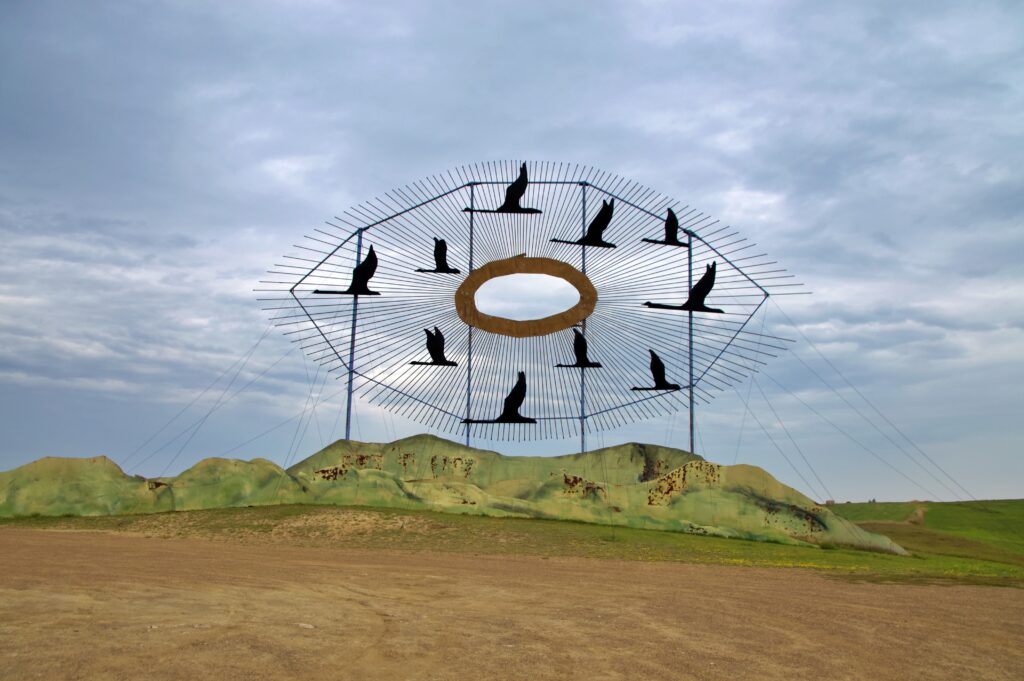
Geese in Flight is the one you can’t miss—110 feet tall, 154 feet wide, visible from the interstate itself. In 2002, it was named the largest scrap metal sculpture in the world by Guinness World Records, a title it still holds. It’s large enough to draw you in, but still surrounded by the same quiet openness as everything else around it.
From there, the road continues south toward Regent.
There’s no need to rush. In fact, the pace of the drive feels better when you don’t. Each sculpture sits with enough distance between them that the road in between becomes part of the experience. You leave one behind, return to open space, and then gradually approach the next.
It doesn’t feel like a sequence of stops as much as it feels like a rhythm.
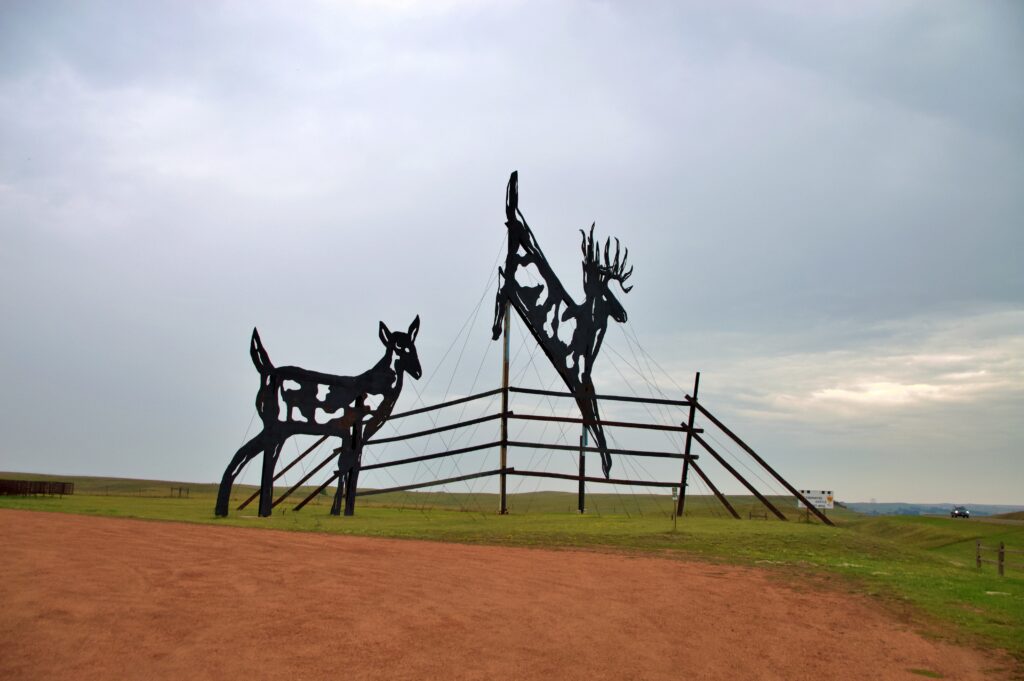
Deer Crossing comes next—a buck frozen mid-leap over a wooden fence, a doe watching from nearby. Unlike most of the other pieces, these are flat, black steel silhouettes rather than sculpted forms, which somehow makes the motion feel even more immediate. There’s something almost cinematic about catching the buck at the top of its jump, cut sharp against the sky.
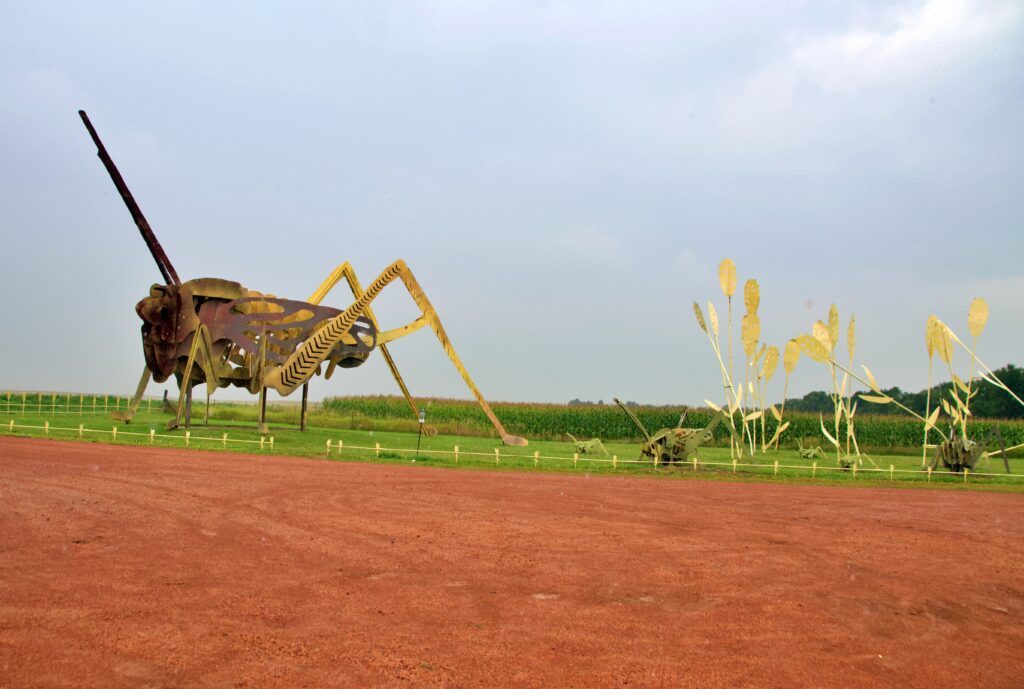
A little further on, Grasshopper’s Delight rises out of a field of golden metal wheat—giant antennae reaching skyward, angular legs braced against the ground. Smaller grasshoppers are scattered in the grass nearby, a quiet nod to the real grasshopper plagues that once devastated wheat crops for the pioneer families who settled this stretch of the state. It’s a strange thing, watching an old hardship turned into something almost playful.
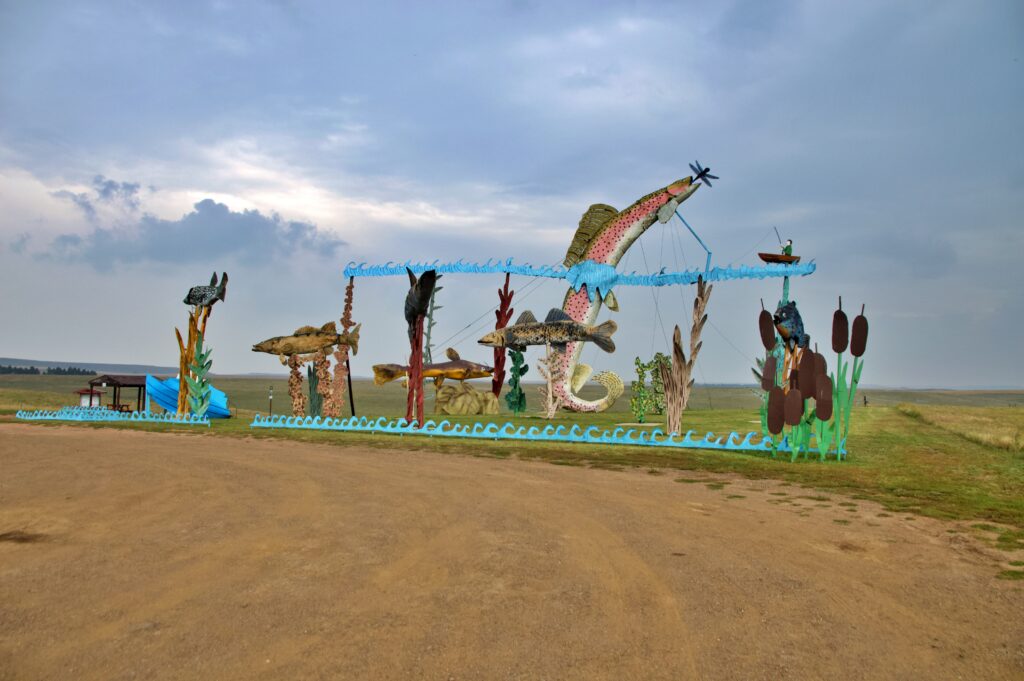
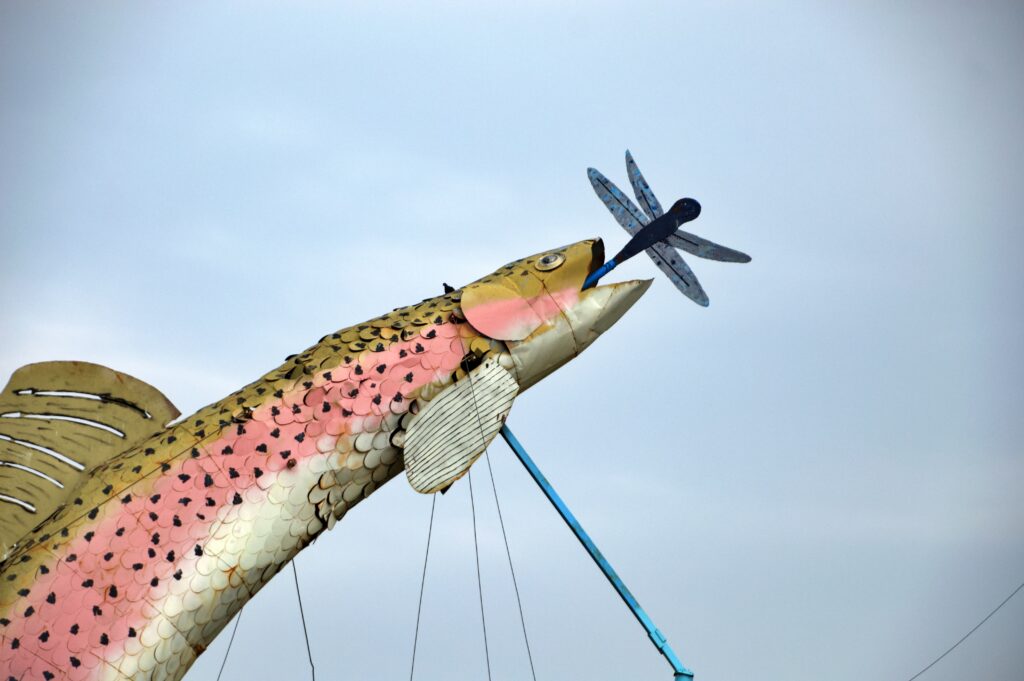
Fisherman’s Dream is the most elaborate scene on the highway—several fish leaping toward a dragonfly above a wave of painted blue metal, with smaller fish, cattails, and a miniature fisherman in his boat filling out the rest. It’s the kind of piece that asks you to get out of the car.
Up close, the detail in the sculptures stands out. Metal shaped into scenes that seem almost in motion despite their size. Knowing they were built by one person, largely alone, out of scrap and persistence, adds another layer entirely.
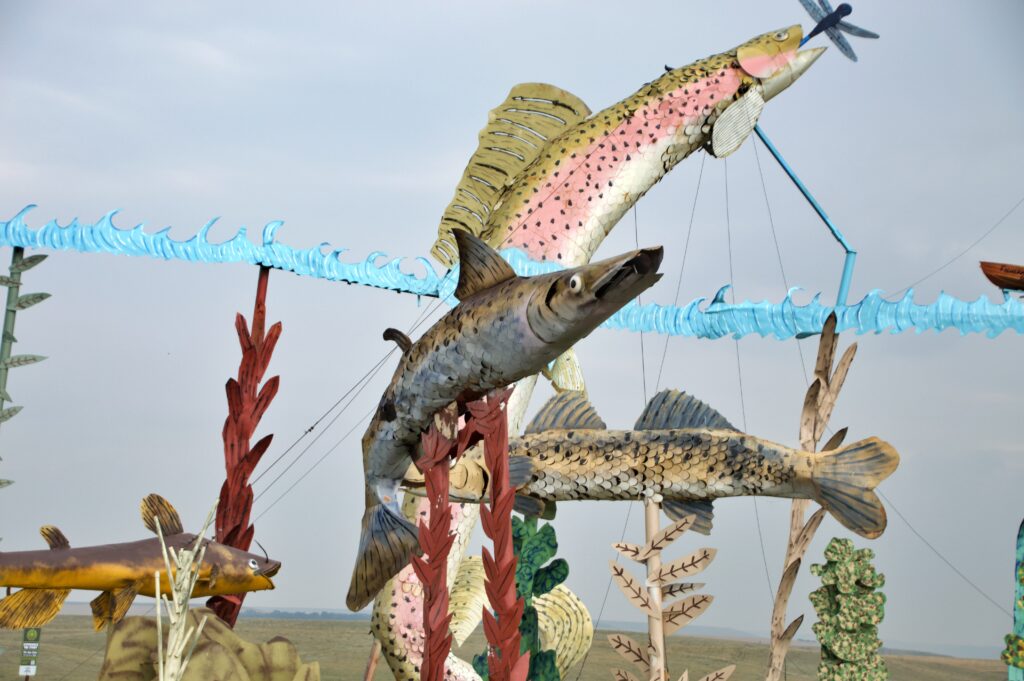
Up close, the layering becomes obvious—fish stacked behind fish, each one with its own posture and color.
And closer still, the centerpiece trout shows individually cut metal scales that shift from olive to pink to white—the kind of detail that’s easy to miss from the road and hard to stop looking at once you’ve seen it.
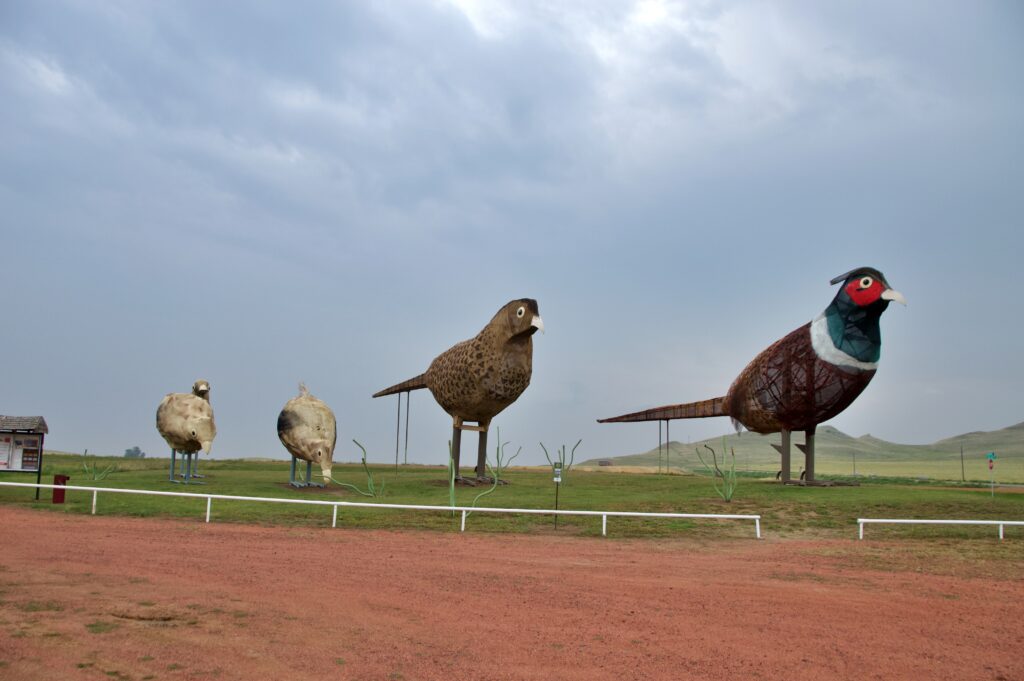
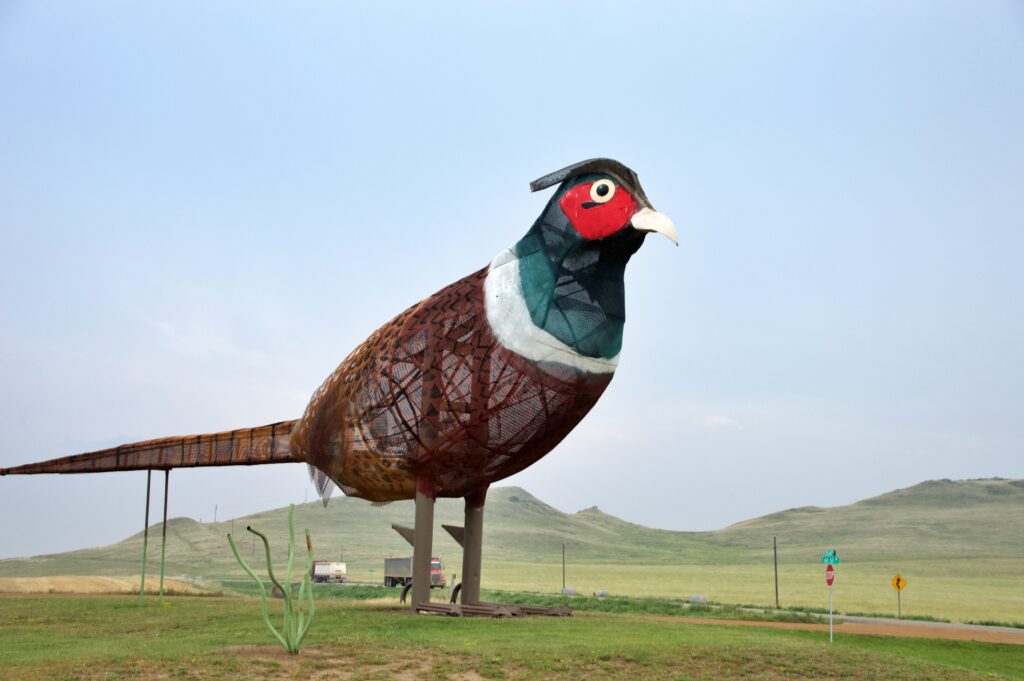
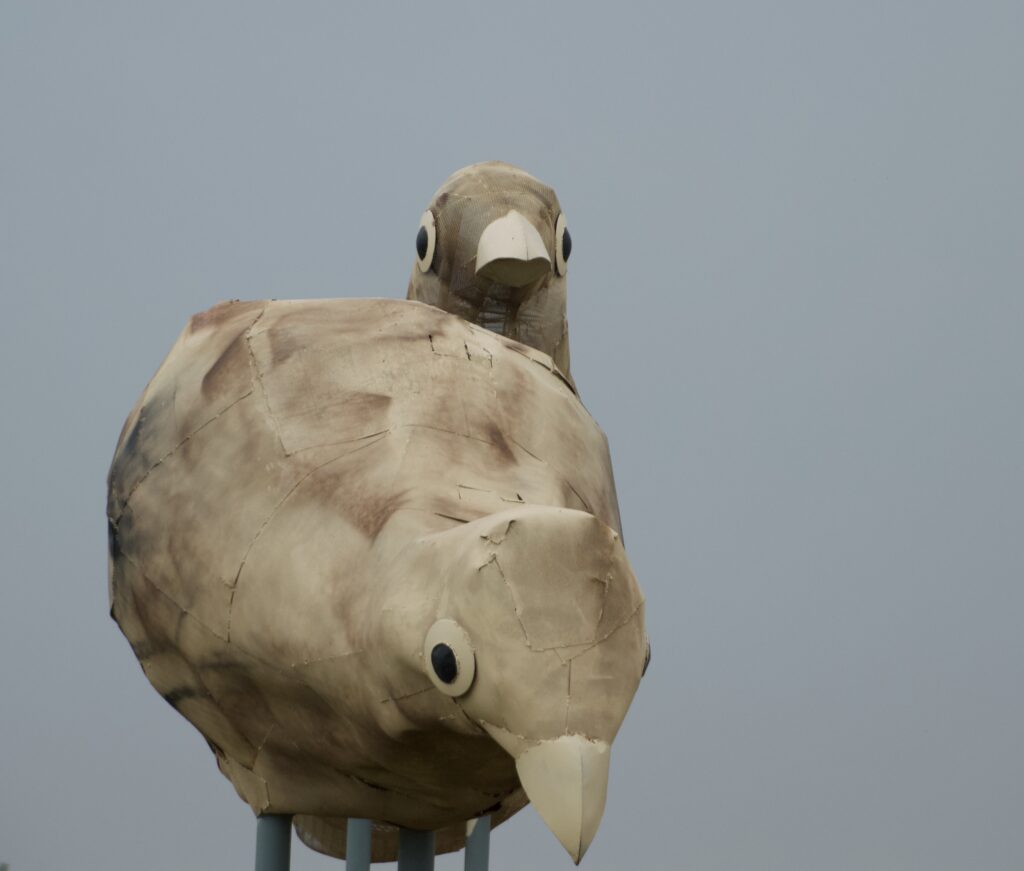
Pheasants on the Prairie gathers a family of birds—an oversized, vividly colored rooster, a more muted hen, and two round, wide-eyed chicks—against the same rolling grassland that surrounds every other piece on the highway.
The male alone is large enough to dwarf the semis passing on the highway beneath it, and the mesh detail in its feathers holds up even at close range.
The two chicks are softer, rounder, almost cartoonish next to the sharp detail of the adult birds—a small reminder that not everything here is built to impress from a distance.
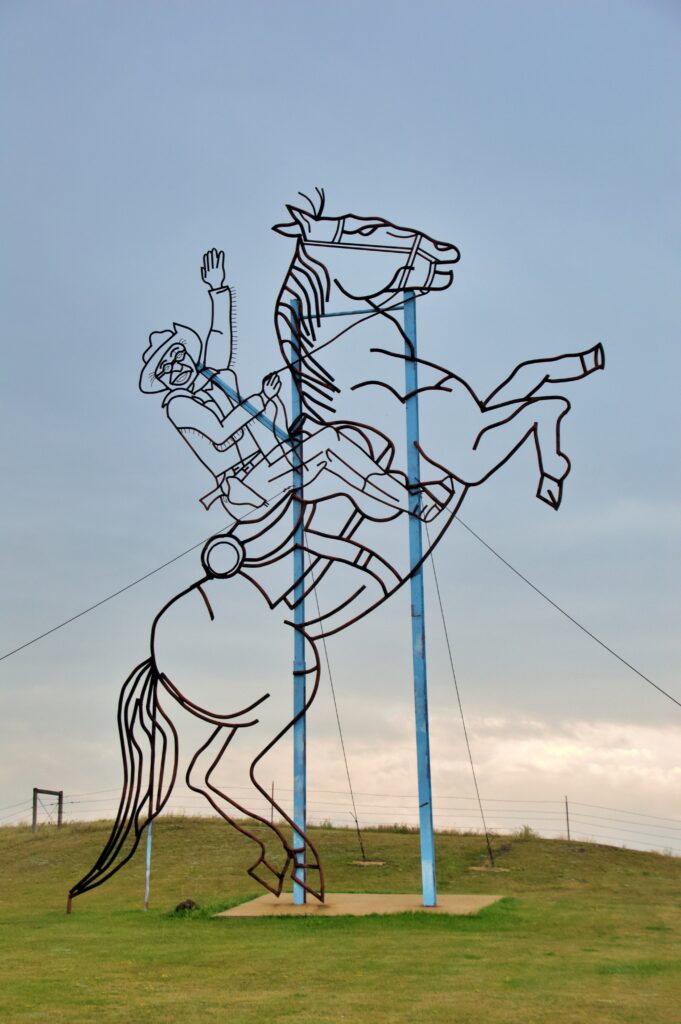
Teddy Roosevelt Rides Again breaks from the wildlife theme—the 26th president rendered in bold, sketch-like outlines, hat raised high atop a rearing horse. Roosevelt spent formative years ranching in North Dakota’s badlands, not far from where this highway ends, and his conservation legacy makes him feel less like a random addition and more like a natural fit for a road built entirely around preserving one small town.
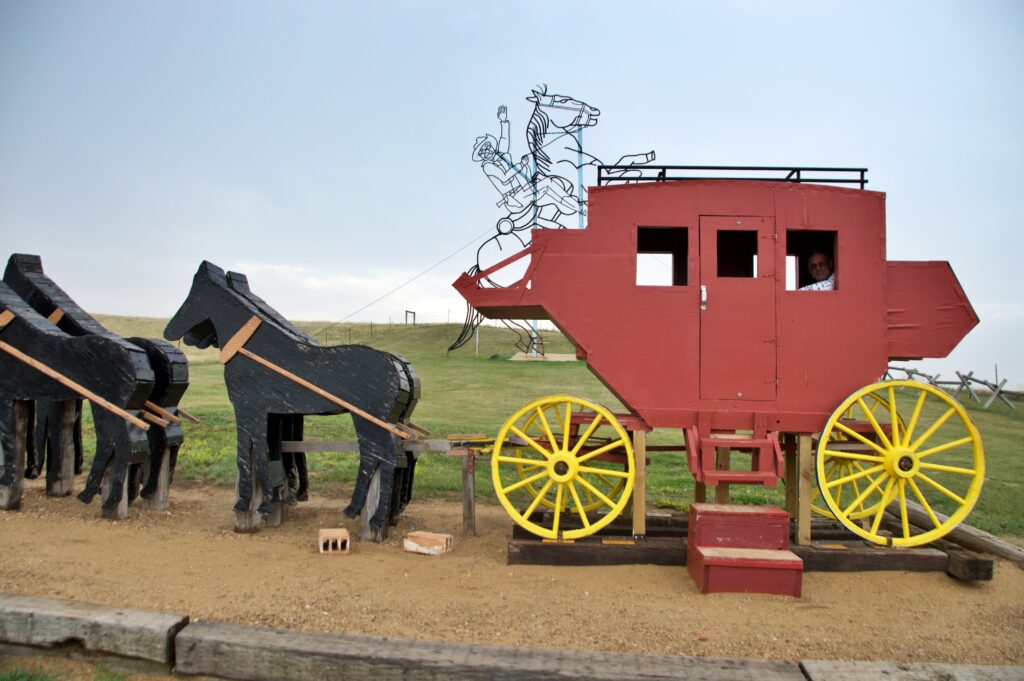
Nearby, a walk-in stagecoach and a team of wooden horses let you step into the scene yourself, the wireframe horse and rider rearing up in the distance behind you. It’s a delightful photo op!
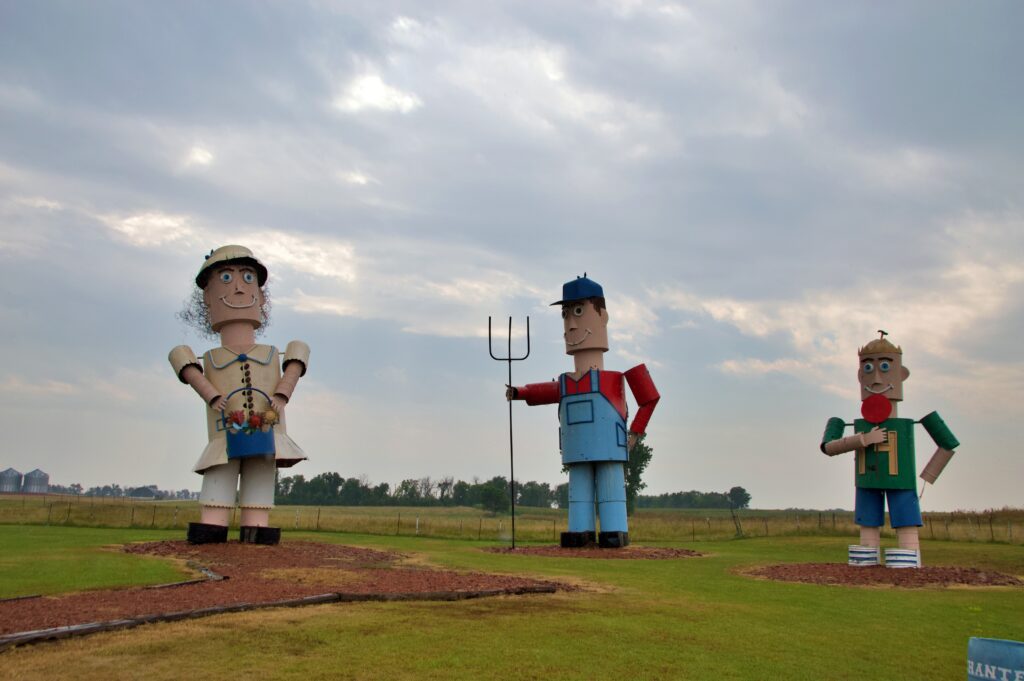
Tin Family is the one that started it all—completed in 1991, long before any of the others existed. A farm mother, father, and son stand in their Sunday best: mother with a basket of flowers, father gripping a pitchfork. It’s modest compared to what came later, almost plain by comparison, but it’s the piece that proved the whole idea could work.
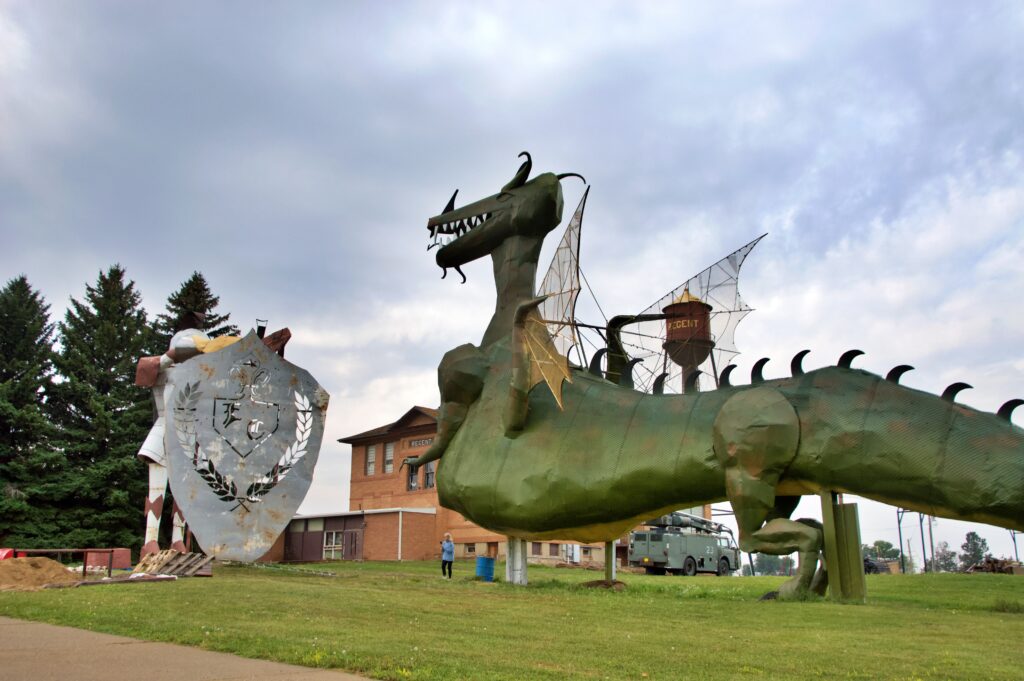
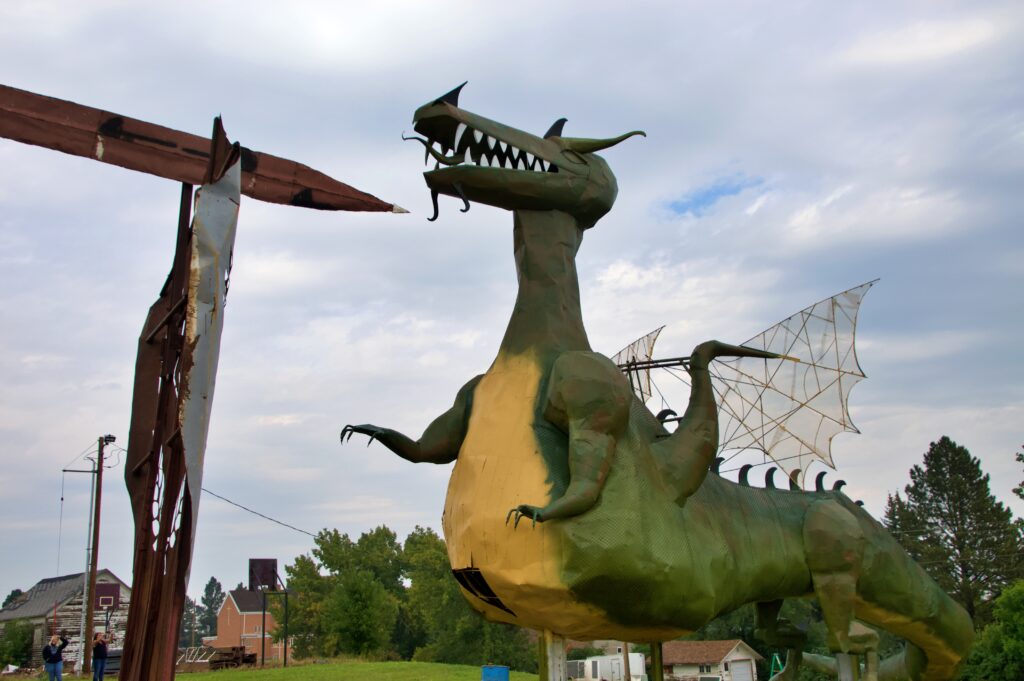
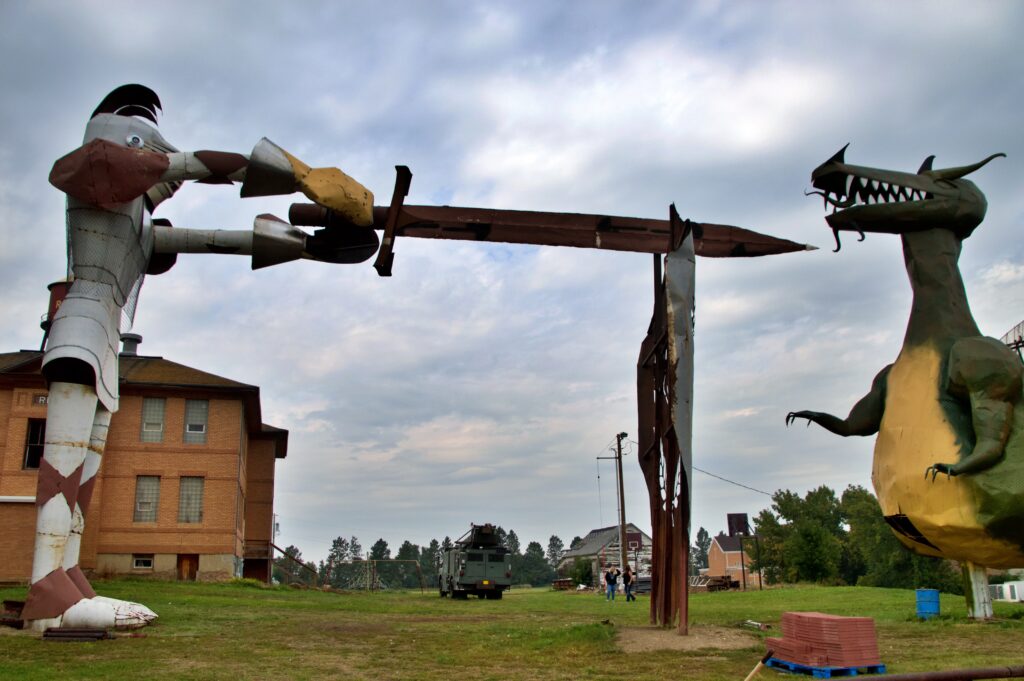
The newest addition, Sir Albert and the Dragon, is also the most dramatic departure—a fully armored knight thrusting a sword toward a fanged, winged dragon, the whole scene towering over Regent’s old brick schoolhouse and water tower.
Up close, the dragon’s jaw hangs open, wings spread wide, its tail curling off toward the edge of the frame.
It was not listed online when we visited—no warning, no mention in any guide we’d checked—which somehow made it more startling than anything else on the highway. Rounding a bend and finding a knight and a dragon mid-battle, with nothing but prairie and an old schoolhouse for context, felt less like finding a roadside attraction and more like walking into a fairytale that happened to be built out of scrap metal.
Where the Landscape Meets the Unexpected
What makes the Enchanted Highway stand out isn’t just the scale of the sculptures—it’s their placement.
They aren’t clustered together or framed as a single attraction. Instead, they are set against the prairie itself, where the land stretches outward with very little interruption.
But it’s not an empty landscape.
This part of North Dakota is shaped as much by agriculture as it is by open space. Large fields extend in every direction, and during parts of the year, the road is shared with enormous farm equipment moving between them. At one point, we pulled over to allow a combine to pass—one of the largest machines I’ve ever seen—slowly making its way down the same two-lane road.
That moment shifts your sense of scale.
The sculptures feel large until something like that moves through the same space. The road narrows, the landscape feels more active, and the quiet you notice at first becomes something more layered—part stillness, part movement, part work being carried out across the land.
A Different Kind of Road Trip Stop
The Enchanted Highway doesn’t demand much from you.
There’s no complex planning, no long hike required, no set itinerary to follow. You can stop at every sculpture or only a few. You can walk around them or just take in the view from the roadside.
It works equally well as a quick detour or as something you build into a longer drive across North Dakota.
And that flexibility is part of what makes it memorable.
Arriving in Regent
At the end of the road, the town of Regent feels consistent with everything you’ve just passed through—small, quiet, and shaped by the surrounding land.
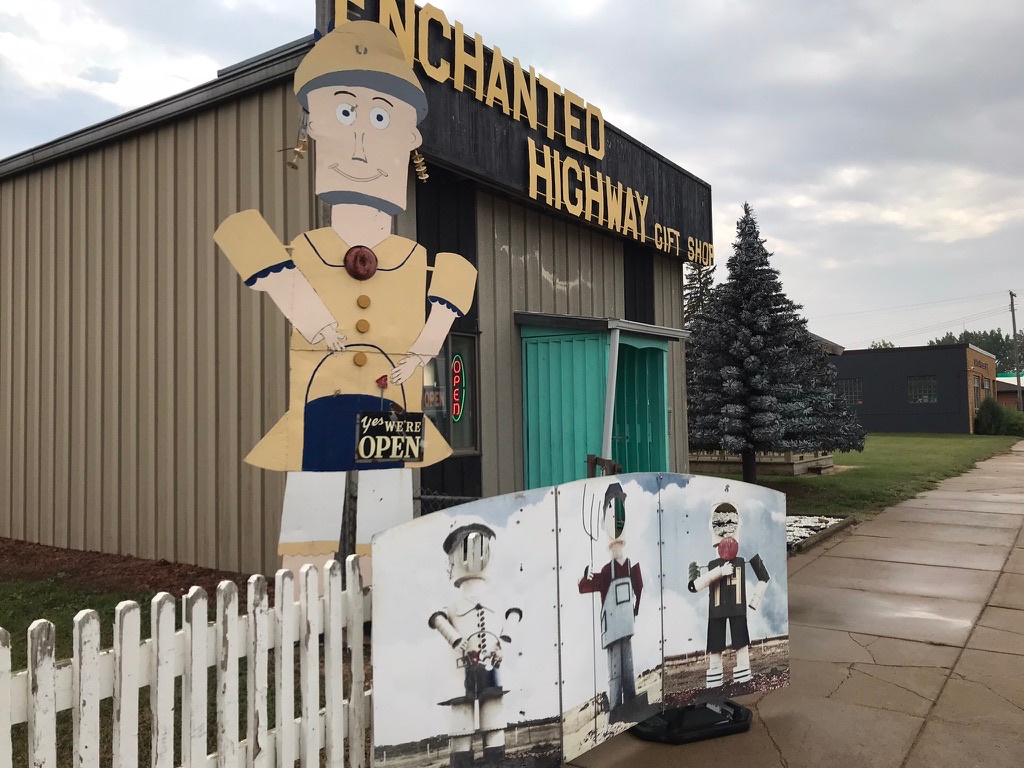
Downtown, the Enchanted Highway Gift Shop carries the same handmade spirit as the sculptures out on the highway—push-button whirligigs and photo cutouts sit outside, and there’s a real chance the person behind the counter is Gary Greff himself, still talking about the project the way he must have thirty years ago.
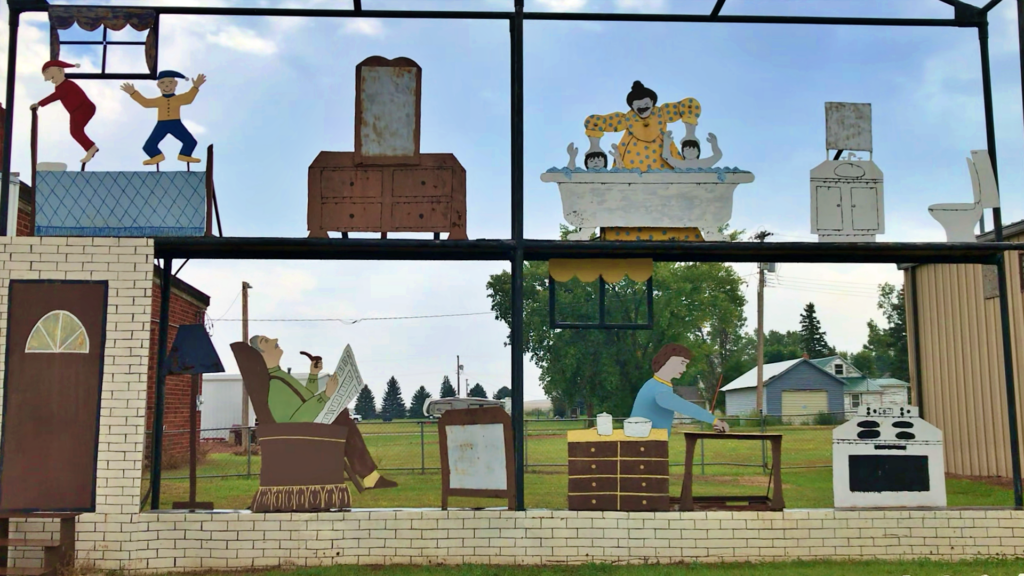
Outside, an animated cutaway farmhouse rewards a push of the button—kids jumping on the roof, a grandmother dunking two squirming children in a bathtub, a father leaning back with his newspaper while dinner cooks nearby. It’s the same sense of humor that built a giant dragon a few blocks away, just scaled down to something that fits on Main Street.
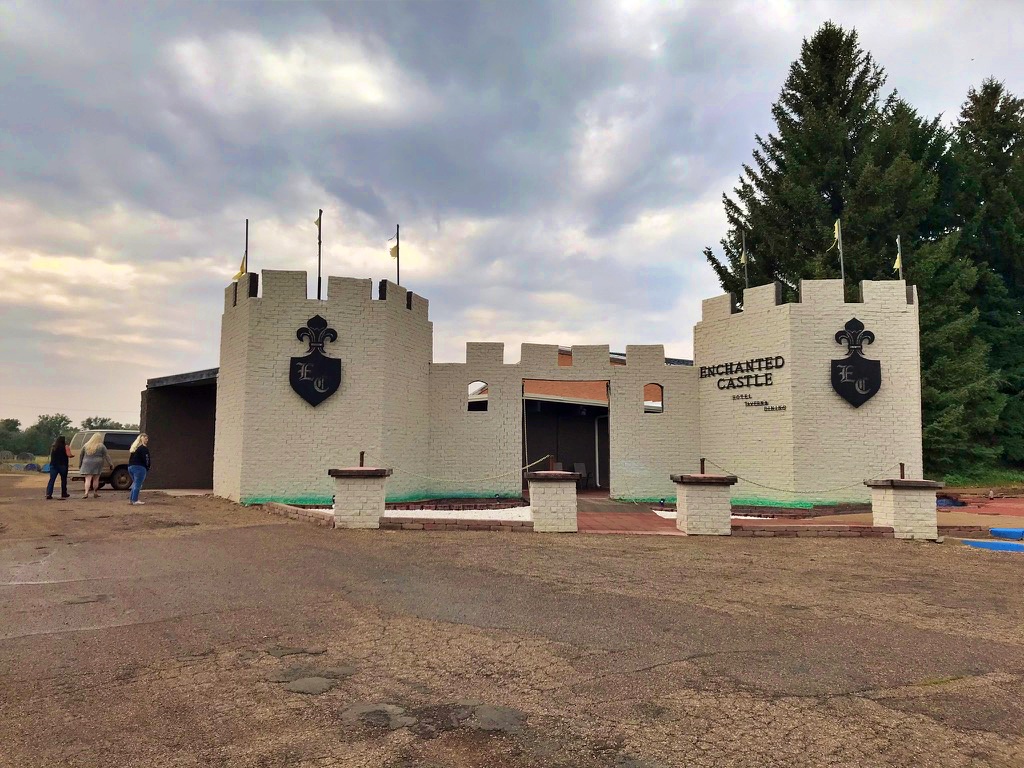
A few blocks over, his Enchanted Castle—a medieval-themed hotel built inside Regent’s old high school—gives the town something else it didn’t have before: a reason for people to stay the night instead of just passing through.
The highway isn’t about a single destination. It’s about the experience of moving through a place where something unexpected appears along the way, then disappears again as the road continues—and about the quiet fact that one person, with no art background and no real plan beyond stubbornness, decided that was worth building.
Why It Stays With You
Some drives are defined by scenery. Others by activity or well-known stops.
The Enchanted Highway is defined by contrast.
Open prairie and large-scale art. Stillness and imagination. Distance and detail. One man’s persistence against a town’s quiet decline.
It’s a reminder that even in places that feel quiet at first glance, there are stories being shaped—sometimes in unexpected ways, and often along roads you almost pass by without noticing.
Planning Your Visit
— Best experienced as a slow, intentional drive, rather than a quick pass-through
— Easily added as a detour off I-94
— Late afternoon or early evening light adds depth to both the landscape and the sculptures
— Minimal crowds, which adds to the overall sense of quiet
— Expect to share the road with large farm equipment, especially during active seasons
Not far beyond Regent, the landscape continues west toward Theodore Roosevelt National Park, where the open prairie begins to give way to the rugged terrain of the Badlands.